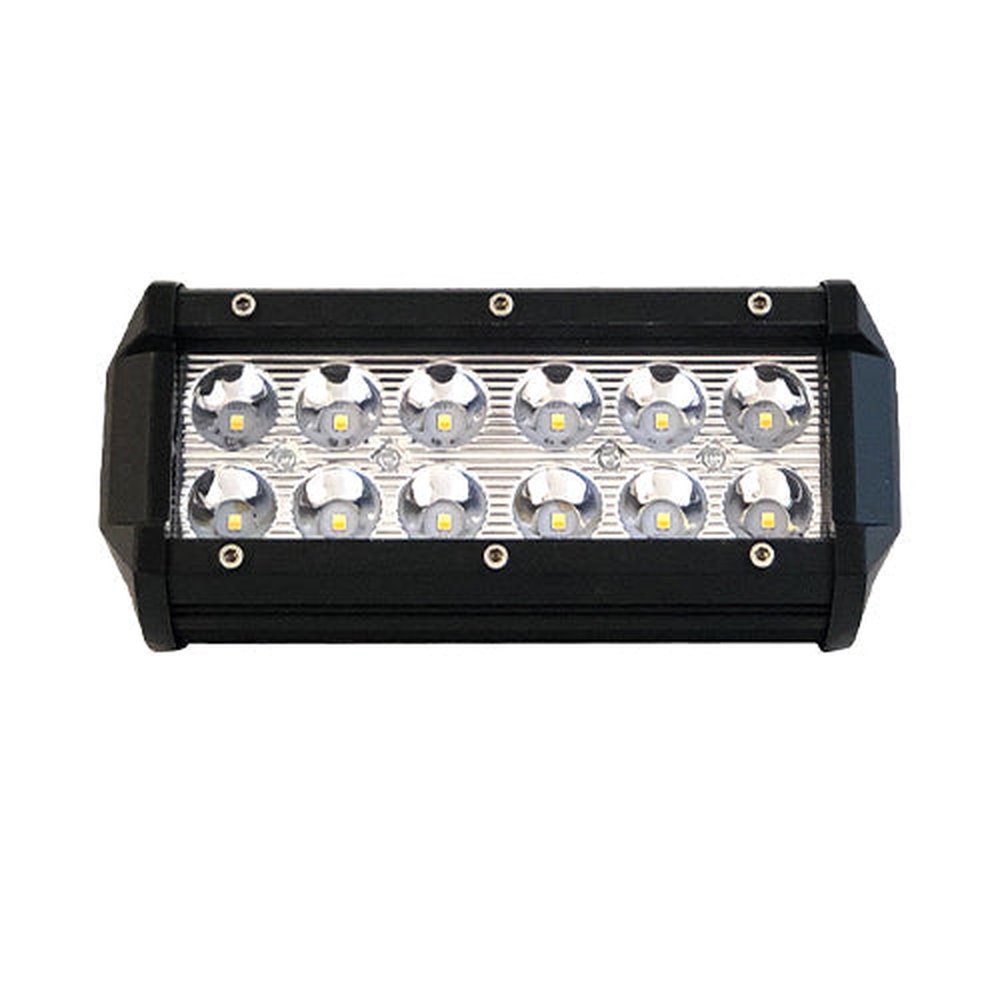
A lamp can pass every photometric test and still be unusable, because the vehicle it is fitted to will not tolerate the electronics inside it. UN ECE Regulation 10 governs electromagnetic compatibility — and it is the requirement most often missing from a cheap LED quotation.
This page explains what R10 covers, why LED lamps create a problem that halogen bulbs never did, how interference actually shows up in a fleet, the difference between a component approval and a vehicle approval, and what to ask a supplier before you commit.
What R10 Actually Governs
R10 is the UN regulation on electromagnetic compatibility (EMC) for vehicles and for the electrical or electronic sub-assemblies fitted to them. It has existed for decades and applies to anything electrical that operates while the vehicle is moving and that could plausibly interfere with something else.
The regulation works on two fronts, and buyers usually only think about the first:
- Emissions. The device must not radiate or conduct unacceptable levels of interference into its surroundings — the vehicle’s own wiring, other vehicles’ radios, roadside equipment.
- Immunity. The device must keep working when interference arrives from outside — electrostatic discharge, load dump, voltage spikes and transients from the alternator and other loads.
One clarification that prevents a lot of confusion: R10 is a UN regulation, not a purely European one. It is adopted far beyond the EU, which is why it turns up in the specification sheets of lamps sold into Africa, the Gulf and Asia.
Why LED Lamps Are a Different Problem From Halogen
A halogen bulb is a resistor. It draws current, it gets hot, and it does very little else — electrically, it is about as quiet as a load can be.
An LED lamp is a small switching power supply. To run LEDs from a 12 V or 24 V system it needs a driver that converts and regulates the supply, and that driver switches on and off tens of thousands of times per second. Add PWM dimming, and you have fast voltage edges moving through wiring that runs the length of a truck and trailer. Three things follow:
- Switching creates harmonics. Fast edges generate energy across a wide frequency band, some of it squarely in the AM, FM and DAB radio bands.
- Long wiring behaves as an antenna. A trailer loom is an efficient radiator. The problem is often not the lamp in isolation but the lamp plus the harness it is fitted to.
- Shared returns spread the problem. Poor earth paths let noise travel into circuits it has no business being in, which is how a work light ends up disturbing a tachograph.
None of this makes LEDs unsuitable. It makes the driver design and the filtering the difference between a compliant lamp and a complaint.
How Interference Shows Up in the Field
EMC faults are frequently misdiagnosed because the symptom appears in a system that has nothing to do with lighting. Use the table as a first-pass triage, not as a diagnosis.
| Symptom | Where you notice it | Most likely cause |
|---|---|---|
| Radio or DAB buzzes, and the pitch changes with brightness or dimming | In the cab, on AM / FM / DAB | Radiated noise from PWM dimming edges travelling along the lamp wiring |
| Tachograph or telematics unit resets or logs errors | In the cab | Conducted noise on a shared supply, often with an inadequate return path |
| Other vehicles report radio interference as you pass | Outside the vehicle | Radiated emissions from the vehicle as a whole |
| ABS or ESP fault appears on a trailer after a lighting change | Trailer | Shared earth or unpaired wiring acting as an antenna — frequently a wiring fault rather than an EMC design fault |
| A “bulb failure” warning appears on the dash | Instrument cluster | Usually not EMC — this is load sensing or CAN-bus bulb monitoring reacting to the low current of an LED |
| Devices behave intermittently only in one circuit | Anywhere on the vehicle | Poor grounding or voltage drop, which mimics EMC problems and is fixed differently |
That penultimate row matters commercially: a “bulb out” warning after fitting LEDs is one of the most common support tickets in this trade, and it is not an R10 problem. It is solved with correct load handling or a CAN-bus-compatible lamp, not with more filtering.
Component Approval vs Vehicle Approval
R10 approvals exist at two levels, and the distinction decides what your supplier can actually put in writing:
- Component (sub-assembly) approval. The lamp itself is approved as an electrical/electronic sub-assembly and carries its own approval documentation. This is what a lighting supplier can legitimately offer you.
- Vehicle (type) approval. The vehicle as a whole is approved with the lighting installed. This is the responsibility of the vehicle manufacturer or the converter who completes the vehicle — not of the lamp supplier.
This is why the honest answer to “is your lamp R10 approved?” is specific: the lamp has a component approval, and whether the finished vehicle remains compliant depends on how it is installed. It also explains why R10 approvals carry a revision suffix — the regulation has been revised repeatedly, and an older approval is not automatically equivalent to a current one.
What to Ask a Lighting Supplier
- “Does this exact SKU hold an R10 component approval?” Not the series, not the family — the SKU on the quotation.
- “Can I see the test report?” Look at the model designation, the voltage range and the revision of the regulation on the report itself.
- “Which revision of R10?” An approval granted under an old revision says less about a present-day vehicle than a current one.
- “Is the driver the same in the 12 V and the 24 V versions?” Different drivers mean different EMC behaviour, and one approval does not prove the other variant.
- “What do you recommend for dimming?” If dimming is done by PWM inside the lamp, the filtering is the supplier’s responsibility; if it is done externally, yours.
Design and Installation Practices That Help
- Keep the return path short and paired. Running a dedicated earth back to the chassis near the lamp is the single most effective installation-level improvement against conducted noise.
- Avoid sharing an earth with sensitive electronics. Tachographs, telematics and radio equipment should not sit on the same return as high-current lighting.
- Do not treat dimming as free. PWM is efficient and cheap, but it is also the most common source of radio whine. Where a lamp offers analogue dimming or a lower-current night mode, that is often the quieter choice.
- Fit-test before you buy a container. One lamp on one vehicle, radio on, dimming swept through its range, will tell you more than any brochure.
Common Mistakes
- Assuming E-mark means EMC-compliant. Photometric approvals and R10 are separate. A lamp can hold R65 or R7 and have no R10 approval at all.
- Blaming the lamp for a bulb-failure warning. That is usually load sensing or CAN-bus monitoring — a different fix entirely.
- Buying on price and fitting to a modern fleet. Older vehicles tolerate noise that current vehicles, with far more electronics on a shared network, will not.
- Skipping the fit test. The failure is cheap to find before the order and expensive to find after the container has cleared customs.
Frequently Asked Questions
Is ECE R10 the same thing as EMC certification?
R10 is the electromagnetic compatibility regulation for vehicles and their electrical sub-assemblies, so for automotive lighting the two phrases describe the same requirement. What the term does not tell you is the scope: an R10 approval can apply to the lamp as a component or to an entire vehicle type, and the two mean very different things when a customer asks whether a product is “R10 certified”.
Why do LED lights cause radio interference when halogen bulbs did not?
A halogen bulb is essentially a resistor and is electrically quiet. An LED lamp contains a switching driver that converts the vehicle supply tens of thousands of times per second, plus PWM circuitry if it can be dimmed. Those fast switching edges generate harmonic energy, and the long wiring of a truck or trailer radiates it efficiently. The interference is a property of the driver design and the installation, not of LEDs in principle.
Do aftermarket LED light bars need R10?
For use on a road vehicle in markets that apply UN regulations, yes — anything electrical that could interfere while the vehicle is moving falls within the scope of R10, regardless of whether the lamp itself is a legally required function. An auxiliary light bar that is outside the scope of the photometric regulations is still inside the scope of the EMC regulation.
What is the difference between an R10 component approval and a vehicle approval?
A component approval covers the lamp as an electrical or electronic sub-assembly, and it is what a lighting supplier can legitimately provide. A vehicle approval covers the whole vehicle with the lighting installed, and it belongs to the vehicle manufacturer or the converter who completes the vehicle. Fitting a component-approved lamp does not automatically make the finished vehicle compliant, because installation affects the result.
Can a load resistor or a filter fix an EMC problem?
They solve different problems. A load resistor or a CAN-bus adapter addresses bulb-failure warnings caused by the low current of an LED, which is a monitoring issue and not an EMC fault. If the actual problem is radio interference, the fix is in the driver design, the filtering and the wiring layout — a resistor does not filter noise and will not help. Diagnose which of the two you have before buying either.
Does R10 apply outside Europe?
Yes. R10 is a UN regulation rather than a purely European one, and it is applied well beyond the EU — which is why it appears in the specifications of lamps sold into Africa, the Gulf, Turkey and much of Asia. In North America the equivalent concerns are addressed through different routes, including FCC rules for equipment and the ISO 11452 and SAE J1113 series for vehicle-level EMC.
Sourcing Lighting That Passes R10
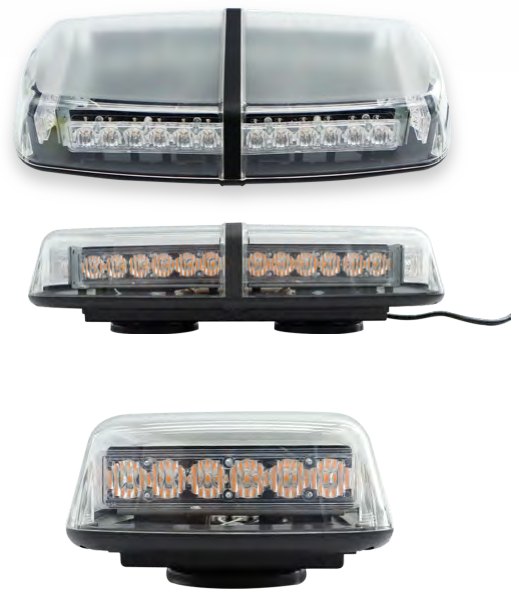
JTPART supplies LED work lights, light bars, beacons and marker lamps for trucks, trailers and plant machinery. Our partnered factories hold ECE R10 approvals on the relevant product lines, and we can supply the test reports and approval documentation with a quotation so you can check the SKU before you commit.
Request R10 documentation and a quotation → or browse light bars, work lights and warning lights.