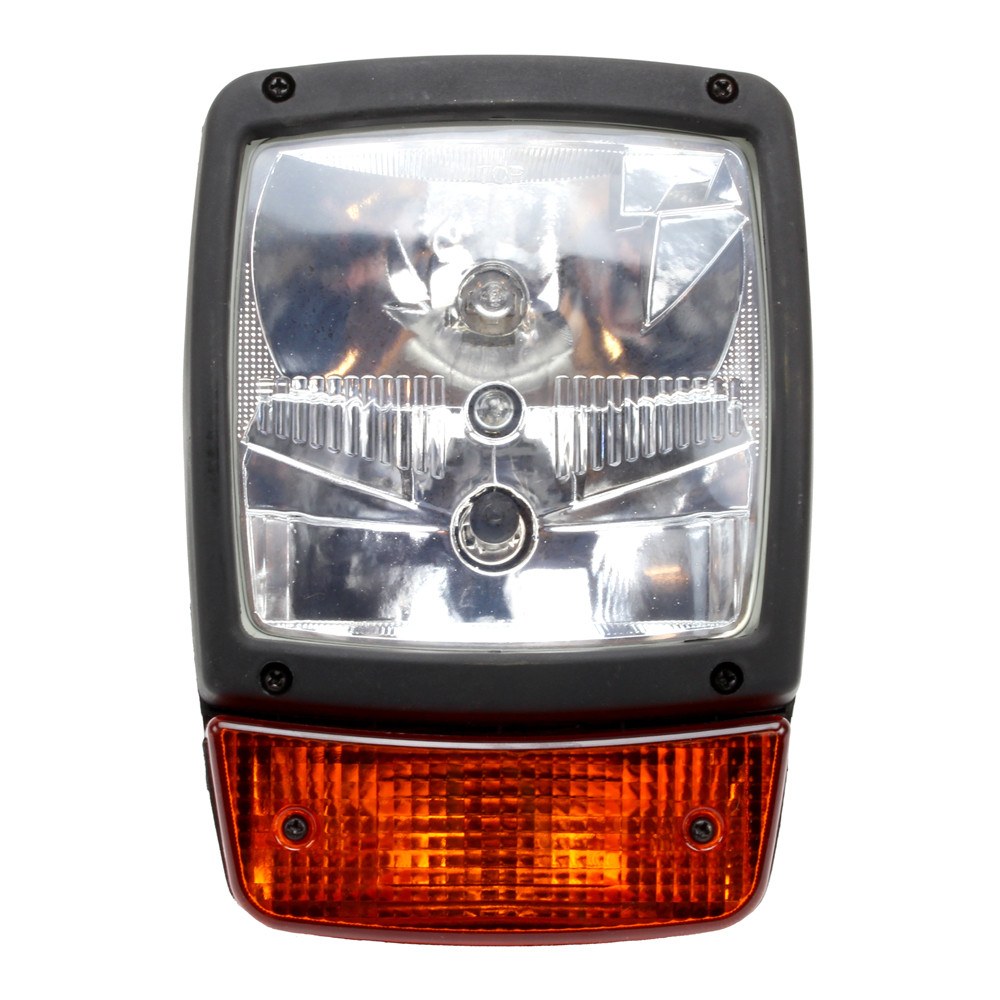
Every ECE-approved lamp carries a small block of moulded codes, and in a dispute that block — not the datasheet, not the quotation, not the sales email — is what an inspector reads. Most buyers glance at the circled E and move on. This page takes the marking apart piece by piece, using the most common format you will see on truck and plant lighting.
Why the Marking Outranks the Paperwork
Under the UN ECE system, a lamp is approved as a design. The approval authority tests a sample, issues an approval number, and the manufacturer is then obliged to keep every production unit identical to the approved design. The marking moulded into the lens is the visible end of that chain.
Three practical consequences follow. First, a lamp without a valid marking is not approved, no matter what the certificate says. Second, the mark travels with the product for its whole life, so a used lamp still carries its own provenance. Third, and most useful commercially: the marking lets you check a supplier’s claim in ten seconds, without their cooperation.
Part 1 — The Circled E and the Country Code
The number inside the circle identifies the authority that granted the approval. It is the most over-interpreted element on the whole lamp.
| Code | Country | Code | Country |
|---|---|---|---|
| E1 | Germany | E13 | Luxembourg |
| E2 | France | E14 | Switzerland |
| E3 | Italy | E17 | Finland |
| E4 | Netherlands | E20 | Poland |
| E5 | Sweden | E21 | Portugal |
| E6 | Belgium | E22 | Russian Federation |
| E7 | Hungary | E23 | Greece |
| E8 | Czech Republic | E24 | Ireland |
| E9 | Spain | E26 | Slovenia |
| E11 | United Kingdom | E27 | Slovakia |
What the code does not tell you: where the lamp was made. A lamp assembled in China, tested at an accredited laboratory and approved by the Dutch authority carries E4. A lamp built in Poland against an approval issued in the UK carries E11. The code identifies the issuing authority, and nothing else.
And the codes are not ranked. There is no hierarchy in which E1 is “better” than E13. Every signatory is obliged to accept approvals granted by the others, so an E13 lamp and an E26 lamp carry identical legal weight in any member market.
One moving part: after leaving the EU, the UK began issuing new type approvals under its own “GB” scheme, while approvals granted earlier under E11 remain recognised. If you are selling into the UK and your approval is recent, it is worth confirming which identifier it carries.
Part 2 — The Function Letters
This is the part buyers skip, and it is the part that answers the only question that matters at an inspection: what was this lamp actually tested to do?
| Marking | Meaning | Why it matters to a buyer |
|---|---|---|
| C | Passing beam (low beam) | A headlamp marked C alone has no approved driving beam. |
| R | Driving beam (high beam) | The pairing of C and R defines whether it is a full headlamp or only half of one. |
| CR | Both passing and driving beam | The normal marking for a complete headlamp. |
| HC, HR, HCR | The same functions in Class B performance | This is not short for “halogen”. It is the higher performance class, and both halogen and LED headlamps use it. |
| DC, DR, DCR | Gas-discharge (HID / xenon) | A different light source with different testing. A lamp cannot be re-lamped between these classes. |
| RL | Daytime running lamp | Increasingly specified on new fleet builds — and a separate approval from the position lamp. |
| A | Front position lamp | The small lamp that must be on whenever the vehicle is. |
| PL | Plastic lens | Declares the lens material, which matters for scratch and UV behaviour. |
| → (arrow) | Traffic side | Asymmetric headlamps are handed. Fitting a left-traffic lamp on a right-traffic vehicle and vice versa throws the beam into oncoming drivers. |
| A bare number, e.g. 25 | Reference value | Caps the driving beam intensity. Higher reference numbers mean more light — and are read directly off the lens by inspectors. |
There is one trap here worth calling out on its own. The H prefix has nothing to do with halogen. Because older reflector headlamps were halogen, the letter has been read as a light-source label for decades. It is not: H denotes the higher performance class under the regulation, and modern LED headlamps carry it as well. A buyer who rejects an LED headlamp because it is “only marked HC” is rejecting a perfectly compliant lamp.
Part 3 — Regulation, Amendment Series and Approval Number
After the function letters comes the regulation itself. You will see it written in two ways — 10R and R10 — and both refer to the same regulation. What matters is not the typography but that you can separate the three values that follow:
- The regulation number — 65 for warning lamps, 10 for electromagnetic compatibility, 148 for light-signalling devices, 112 or 149 for headlamps.
- The amendment series — typically a two-digit number. This is the version of the regulation the lamp was approved against. It is the single most ignored digit on the lens, and it is the one that decides whether the approval is current or a decade old.
- The approval number — the individual sequence assigned to that design. It is what a supplier traces back to a test report.
Read together, 10R-06 1234 says: approved to Regulation 10, at amendment series 06, under approval number 1234. Ask for the same string on the certificate the supplier sends you. If the two do not match character for character, you are looking at a document for a different product.
When One Lamp Carries Several Approvals
A combination tail lamp is not one approval; it is several, printed together. A typical rear lamp serving stop, tail, indicator and reflector might show something like E11 R7 R6 R3 02 12345, in which R7 covers the position and stop functions, R6 the indicator and R3 the retro-reflector, with the series and approval number applying across the block.
This has a direct commercial consequence. A combination lamp is only as sellable as its weakest function. If the indicator function carries no R6 approval, the lamp is not a compliant indicator lamp in any market that applies UN regulations — however good the stop lamp function is. When you audit a sample, work through the blocks one by one rather than reading the mark as a single stamp.
R148 and R149 — Why Newer Lamps Look Different
From 2018 the UN consolidated a large group of older regulations into two documents, and approvals issued since have increasingly cited the new numbers rather than the old ones:
| Consolidated regulation | Covers | Replaces |
|---|---|---|
| R148 — light-signalling devices | Position lamps, stop lamps, indicators, reversing lamps, rear fog lamps, daytime running lamps, side markers, end-outline markers | R6, R7, R23, R38, R77, R87, R91 |
| R149 — road illumination devices | Headlamps and front lighting — passing beam, driving beam, front fog, cornering lamps, adaptive systems | R19, R98, R112, R113, R119, R123 |
Practically, this means two lamps that are functionally identical may carry different numbers depending on when they were approved. An R7 marking is not “worse” or “outdated” than an R148 marking, and an authority that accepts one accepts the other. What you should not accept is a supplier mixing the two in the same datasheet to make an old design look new, or quoting R148 for a lamp whose lens says R91.
How to Verify an E-Mark Claim
- Get the marking, not the claim. Ask for a close-up photograph of the moulded mark on the actual SKU you are buying — not a marketing image, and not a different model in the same series.
- Check all three required elements. Country code, regulation number and approval number. A mark missing any of them is not a valid E-mark.
- Check it is moulded or laser-etched. A printed sticker on the housing is not an approval.
- Match the regulation to the function. A beacon must cite R65. A lamp citing R65 while being sold as a work light is a mismatch, not a bonus.
- Request the approval certificate and reconcile the numbers. Model designation, approval number and amendment series must match the lens exactly.
- Check the amendment series is current. An approval several series behind says less about a present-day vehicle than a recent one.
- Confirm the same approval covers the variant you are buying. A 24 V version with a different driver is not automatically covered by the 12 V approval.
Four Misreadings That Cost Buyers Money
- “E1 means German quality.” It means the German authority approved the design. Manufacturing location is unrelated.
- “H means halogen.” It means Class B performance, and applies to LED headlamps too.
- “More codes printed means a better lamp.” It usually means more functions are combined in one housing — useful, but each still has to be verified separately.
- “The number after the E is the approval.” The country code is not the approval number, and neither is the regulation number. All three are distinct.
Where This Fits in the Wider Compliance Picture
Reading an E-mark is one skill; knowing which framework a lamp is judged against is another. These pages cover the neighbouring pieces, and each one relies on markings you can check yourself:
To see markings on real product, start with the headlamp range — for example the JT-HL09 vertical-mount headlamp and the JT-HL13 LED headlamp assembly, both of which carry their approval markings on the housing.
Frequently Asked Questions
Can a lamp made in China legally carry an E-mark?
Yes, and most road-legal lamps sold into Europe do. The E-mark is granted to a design by a UN ECE approval authority, which will have tested samples at an accredited laboratory. The country code identifies the authority, not the factory: a lamp produced in China can carry E4 (Netherlands), E13 (Luxembourg) or any other signatory code. What matters is that a genuine approval exists and that the production units match the approved design.
Is an E11 approval invalid now that the UK has left the EU?
E11 approvals granted while the UK was part of the ECE type-approval system remain recognised, and the UK continues to accept UN ECE approvals on vehicles and components. For new approvals the UK operates its own scheme with a GB identifier. In practice, both are normal to see on product in circulation, and the practical check is unchanged — that the marking is complete, matches the certificate and covers the exact SKU you are ordering.
What does the number after the regulation, such as 10R-06, actually mean?
The two digits are the amendment series — the version of the regulation the lamp was approved against. R10 has been revised repeatedly as vehicle electrical systems have changed, and the series number on the lens tells you which revision applied at approval. A lamp approved under an early series may still be perfectly functional, but it was not assessed against the more demanding tests a current series imposes, and some fleet specifications now state a minimum series for new purchases.
Why does my lamp show R7 and R148 so inconsistently across products?
Because the consolidated regulations were introduced progressively, and approvals are not reissued automatically when a regulation is absorbed. An older product keeps its original R7 approval; a newer one designed after the consolidation is approved under R148. Functionally both may be equivalent, and authorities accept both. The inconsistency only becomes a problem if a datasheet quotes one while the lens shows the other.
Do auxiliary light bars carry an E-mark?
Generally not, and this is not a defect. Auxiliary driving lamps and light bars sit outside the scope of the UN ECE photometric regulations, because those regulations define the lamps a vehicle is required to have. A light bar may still carry an R10 approval for electromagnetic compatibility, which is a separate requirement and one worth asking about. Road legality for auxiliary lighting is decided by national and local law, not by an approval on the lamp itself.
Checking the Marking on the Lamps We Supply
JTPART supplies headlamps, work lights, light bars, beacons and marker lamps for trucks, trailers and plant machinery. Our partnered factories hold ECE approvals on the relevant product lines, and we will send close-up photographs of the moulded markings together with the matching approval documentation before you commit to an order — so you can reconcile the numbers yourself.
Request markings and approval documents → or browse headlamps, warning lights and marker lamps.