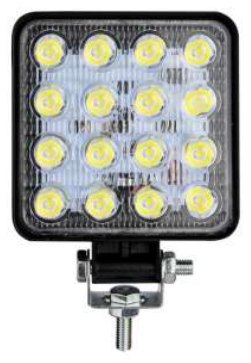
“IP68” and “IP69K” are not two levels of the same thing. They are two different tests, and a lamp can pass either one while failing the other. For a truck, trailer or plant machine, picking the wrong one shows up as condensation behind the lens in the first winter, or a dead work light after the first steam clean. This page sets out what each rating actually proves and which one suits which position on a vehicle.
What an IP Code Actually Tells You
An IP rating is two digits. The first is protection against solid objects and dust; the second is protection against water. They are tested separately, and one says nothing about the other.
The first digit matters more than buyers expect. 6 means dust-tight, verified with the enclosure held at reduced pressure so that any ingress would be forced. 5 means dust-protected, which permits ingress as long as it does not interfere with operation. On a truck lamp the first digit is almost always 6 in a serious product, because dust and grit are everywhere and a lamp that admits dust will fog its own lens.
| Second digit | Test | What it proves on a vehicle |
|---|---|---|
| 4 | Splashing water from any direction | Survives incidental splash. Not adequate under a truck. |
| 5 | Water jets, 6.3 mm nozzle, 12.5 L/min at 3 m | Survives a gentle hose-down. |
| 6 | Powerful water jets, 12.5 mm nozzle, 100 L/min at 3 m | Survives heavy spray and pressure washing at a distance. |
| 7 | Immersion at 1 m for 30 minutes | Survives being submerged briefly — flooding, deep puddles, a short river crossing. |
| 8 | Continuous immersion, depth and duration declared by the manufacturer | Whatever the datasheet states — which is why the small print is the whole story. |
| 9K | High-pressure, high-temperature jets: 80–100 bar at 80 °C, 14–16 L/min, from 10–15 cm, at four angles | Survives repeated steam and pressure washdown at close range. |
The Three Ratings Side by Side
| IP67 | IP68 | IP69K | |
|---|---|---|---|
| Defined in | IEC 60529 | IEC 60529 | DIN 40050-9, now carried in ISO 20653 |
| Water test | 1 m depth, 30 minutes | Continuous immersion; depth and duration set by the manufacturer | 80–100 bar jet at 80 °C, 14–16 L/min, 10–15 cm distance, 0/30/60/90° |
| Water state | Standing, cold | Standing, cold | Moving, hot, high velocity |
| What it targets | Short flooding and splash | Long-term submersion | Thermal shock plus physical water drive |
| Typical truck use | Underbody, chassis, wheel arches, trailer lamps | Lamps that may sit submerged — tanker and wash bays | Fleets that steam-clean equipment; plant and ag machinery |
| Dust digit | 6 in a serious lamp | 6 in a serious lamp | 6 in a serious lamp |
IP69K Is Not a Higher Version of IP68
The maths-looking part of the code leads people to assume 9 is above 8 is above 7, and therefore that an IP69K lamp is the safest choice for everything. That is wrong, and it is the most expensive mistake in this area.
IP69K tests a hot, close-range, high-velocity jet. That combination attacks seals in a way that immersion never does: it drives water into any gap under pressure, and the 80 °C water thermally shocks the seal material on every pass. It does not test whether the lamp survives sitting under a metre of water for an hour. A manufacturer can build a lamp that sheds a pressure jet beautifully and still takes on water when left submerged, because the two failure paths are different.
The reverse is equally true. A properly sealed IP68 lamp may have seals that degrade under repeated thermal cycling at 80 °C — which is why washdown environments have their own rating at all.
The rule to remember: if you need both — a lamp that is submerged and steam-cleaned — the datasheet must state both ratings. IP69K does not imply IP67 or IP68, and IP68 does not imply IP69K. Where you see only one, assume only that one has been tested.
What an IP Rating Does Not Cover
The rating answers one question well and five questions not at all. For truck lighting, these are the gaps that cause field failures:
- Chemicals. The water tests use water. Detergents, degreasers, diesel, AdBlue, brine and fertiliser are outside the scope entirely, and they are what actually destroys seals and housings in service. Chemical compatibility is a separate conversation with the supplier.
- UV and weather. A rating says nothing about lens yellowing, seal hardening or housing embrittlement after years of sun and frost. That is a material choice, not an IP claim.
- Temperature cycling. The water tests are essentially isothermal. A lamp that cycles between −25 °C and +80 °C repeatedly will breathe through its seals, and that mechanism is how most condensation gets in.
- Vibration and mechanical shock. No water test shakes the lamp. On a truck or a compactor, vibration is a primary failure mode.
- The cable entry. This is where most water actually enters. The rating applies to the enclosure as tested; if the grommet, connector or gland is fitted or routed differently on your vehicle, the test result does not automatically transfer.
- Condensation from the inside. A perfectly watertight lamp can still fog if it was assembled in humid air. Pressure-equalising vents and desiccant handling are a quality issue the IP code cannot express.
Which Rating for Which Position on a Truck
| Position or operating condition | Sensible minimum | Notes |
|---|---|---|
| Cab headlamps, front position lamps | IP67 | Rain, spray and road dirt. Higher is rarely needed. |
| Chassis and underbody work lights | IP67, IP68 preferred | Deep puddles and long exposure to wet road film. |
| Trailer rear and marker lamps | IP67 minimum | Most complaints about “LED lamps that died” trace back to water finding the cable entry. |
| Roof-mounted light bars | IP67 | Wind-driven rain at speed is harder on seals than static water. |
| Tankers, wash bays, anywhere the lamp can sit submerged | IP68, with the declared depth and duration stated | Ask for the datasheet figure. “IP68” alone is not a specification. |
| Fleets that steam-clean or pressure-wash equipment daily | IP69K (and IP68 too if the lamp is also submerged) | Thermal shock is the failure mode, not depth. |
| Plant and agricultural machinery | IP69K or IP67+IP68 depending on washdown practice | Dust is as much an enemy as water here — confirm the first digit is 6. |
| Food, dairy or pharma-adjacent equipment | IP69K | The application this standard was originally written for. |
How to Write It Into a Purchase Order
An IP claim is only useful if it is specific enough to be checked. Four lines in the specification do most of the work:
- State the full code. Write IP67, IP68 or IP6K9K completely — not “waterproof”, and not “IP68/IP69K” as though they were interchangeable.
- For IP68, force the numbers out. The regulation requires the manufacturer to declare the depth and duration. Write them into the PO, for example “IP68 at 2 m for 30 minutes”. If the supplier cannot fill in the blank, the claim was marketing.
- For IP69K, confirm it is the full test. Ask whether the four spray angles and the 80 °C water temperature were used, and whether there is a test report.
- Specify the cable entry as part of the rating. Ask how the enclosure was sealed at the entry point during the test, and whether the supplied connector is the same component.
Two more things belong in the specification even though they are not IP codes: a defined operating temperature range, and a statement of chemical resistance for the cleaning agents your fleet uses. Those two lines catch more real-world failures than upgrading the water digit ever will.
Related Reading
Water ingress is one of three things that decide whether a lamp survives on a working vehicle. These pages cover the other two, and the framework a lamp is judged against:
For lamps built for the harder end of these conditions, see the work light range and the light bar range — the JT-WL001 work light and the HY-206-36 mini light bar are typical examples of sealed units specified for chassis and roof positions.
Frequently Asked Questions
Is IP69K better than IP68?
Not better — different. IP69K proves resistance to a close-range jet of water at 80 °C and 80–100 bar, which is what steam and pressure washdown does. IP68 proves resistance to continuous immersion, at a depth and duration the manufacturer declares. A lamp built for one is not automatically suitable for the other, and a fleet that both submerges and steam-cleans its equipment needs both ratings stated on the datasheet.
Do truck LED lights really need IP68, or is IP67 enough?
For most positions IP67 is enough, and buying IP68 everywhere is money spent on a test that does not match the duty. The exceptions are lamps that can be submerged: tankers, wash bays, dumpers working in standing water, and any underbody position that sits in deep water rather than spray. The cheaper and more reliable upgrade for a general fleet is usually a better cable entry and a defined temperature range, not a higher water digit.
What does the number in IP68 actually mean if it is written after a slash?
Where you see two figures such as IP68 at 1.5 m for 30 minutes, the manufacturer is completing the requirement that IP68 is not a fixed test. Unlike IP67, which specifies 1 m for 30 minutes, IP68 leaves depth and duration to be agreed and declared. That is precisely why an unqualified “IP68” claim on a datasheet is close to meaningless on its own.
Why do my lamps fog up if they are supposed to be waterproof?
Condensation is usually not an ingress failure. Air trapped inside the lamp at assembly carries moisture; when the lamp cools, that moisture condenses on the inside of the lens. It can happen on a lamp that passes every water test. The usual fixes are assembly in controlled humidity, an appropriate pressure-equalising vent, and in some designs a desiccant. That is a manufacturing quality matter, not an IP rating, which is why two lamps with identical markings can behave differently.
Does an IP rating cover pressure washing at close range?
Only IP69K does. IP67 and IP68 test immersion and jetting under gentler conditions, and a close-range pressure washer can exceed what IP67 or IP68 was ever designed to prove. If your maintenance routine involves a lance held close to the lamp, specify IP69K rather than assuming a waterproof lamp will cope.
What should a supplier give me to prove an IP claim?
A test report identifying the enclosure tested, the exact code, and for IP68 the declared depth and duration. Photographs of the test set-up are useful, and so is a statement of which sealing component was fitted at the cable entry during the test. A code printed on a datasheet with no underlying report is an assertion, not evidence.
Specifying IP Ratings on Lighting Orders
JTPART supplies work lights, light bars, beacons and marker lamps for trucks, trailers and plant machinery, in IP67, IP68 and IP69K versions depending on the range. Our partnered factories hold the relevant approvals on these product lines, and we will state the declared IP figures, the test conditions and the cable-entry arrangement in writing on the quotation — so the specification you approve is the specification you receive.
Ask for IP specifications → or browse work lights, light bars and marker lamps.