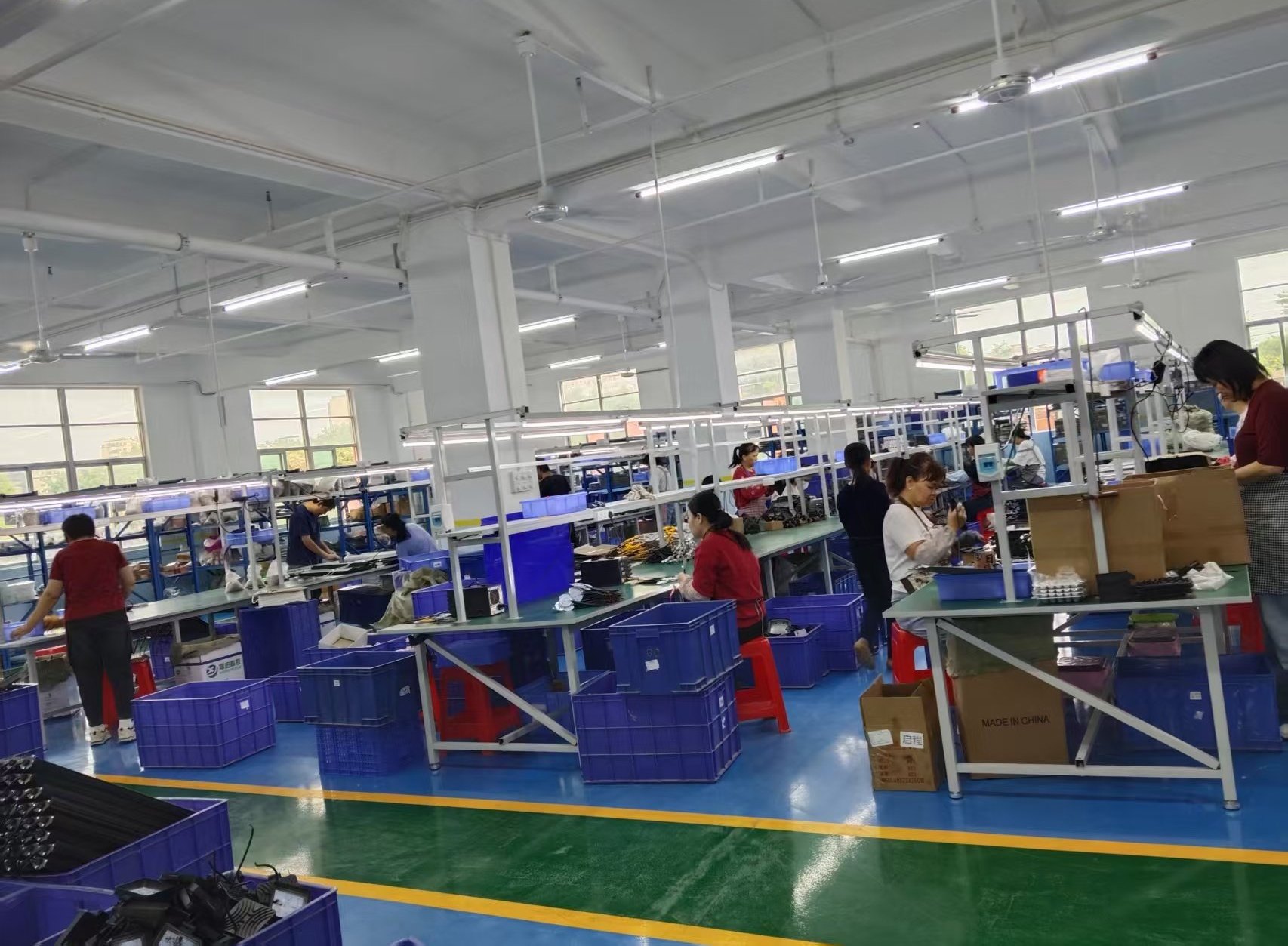
Buyers treat OEM, ODM and private label as three grades of sophistication, as if full custom were the trophy at the end. They are not grades. They are four positions on one axis: how much of the product you own — its design, its tooling, its approval, and its problems. Choosing the wrong position does not usually get you a bad lamp. It gets you a lamp that cost more, arrived later, and carries obligations you did not know you had signed up for.
This guide is the third piece in our sourcing series, after the full sequence and supplier verification. Here we stay on one commercial decision: which cooperation model fits your business. The honest answer depends less on the buzzword a supplier puts in the quotation and more on three things most first-time buyers leave out: who holds the approval, who pays for the tooling, and what happens on the day the product changes.
What the Words Actually Mean (and How Quotations Misuse Them)
The definitions are simple. The market’s usage of them is not. On sourcing platforms, “OEM/ODM available” appears on almost every lighting supplier’s page, and in practice it usually means one thing: they can print your logo. That is private label — a legitimate and often correct choice, but a different product decision from what the word “OEM” describes in an engineering contract.
Strictly defined:
- Private label. The supplier’s existing product, unchanged, sold with your brand on the label and packaging. You change nothing about the lamp itself.
- ODM (original design manufacturer). The supplier owns the design and manufactures it; you select from their range and may configure within limits — cable length, connector, colour, lens tint, packaging, sometimes housing finish. The design remains theirs, and they may sell the same platform to others.
- OEM (original equipment manufacturer). You bring the specification — sometimes the full design — and the factory manufactures to it. The design is yours by contract. Tooling, if new shapes are involved, is usually funded by you.
- Full custom. OEM taken to the end: new tooling, new electronics, a product type that did not exist in the factory’s range, and an approval built from zero.
When a quotation says “OEM”, it is worth one follow-up question before any price discussion: what exactly would be different from your standard lamp? The answer sorts most quotations into their true column within a minute.
| What the quotation says | What it usually means | The question that sorts it out |
|---|---|---|
| “OEM/ODM welcome” | Private label: your logo on their lamp | “Can you change the lens pattern, or only the label?” |
| “ODM, we customise for you” | Configurable options on an existing platform: cable, colour, packing | “Who owns the housing design if we stop ordering?” |
| “OEM, produce to your drawing” | Genuine manufacture to your specification | “Which tooling is new, and who funds it?” |
| “Same as X brand” | A look-alike with no relationship to the named brand | Walk away, or verify the approval separately |
| “Customised for your market” | Usually packaging, language and plug/connector only | “Show me the engineering difference on the datasheet.” |
The Full Comparison, Dimension by Dimension
With the words settled, the trade-offs become visible. Every row below is a cost, a delay, a risk, or a freedom — and each one moves in the same direction as you move right along the axis in Figure 1.
| Dimension | Private label | ODM (configured) | OEM (your spec) | Full custom |
|---|---|---|---|---|
| Who designs the lamp | Supplier | Supplier | You | You |
| Design exclusivity | None — sold to anyone | None, options may be exclusive | Yours by contract | Yours, patentable |
| New tooling required | No | Rarely | Usually | Always |
| Tooling cost | None | Rarely | Typically the buyer funds | Buyer funds |
| Approval status | Existing type approval | May extend to your options | Must be re-established | From zero |
| Typical sampling time | ≈1–2 weeks | ≈2–4 weeks | ≈6–12 weeks incl. tooling | Longer still |
| Typical first-order minimum | Lowest | Low to moderate | High | Highest |
| Where quality risk sits | Supplier’s proven product | Configuration changes | Your specification | Everywhere |
| Differentiation you can sell | Price, stock, service | Options and packaging | The product itself | The product itself |
| If the relationship ends | You re-source the same lamp | You re-source the same lamp | Tooling ownership decides | Tooling ownership decides |
A note on numbers: ranges in this article are industry-typical patterns, not quotations. Tooling cost for a lamp housing, for example, spans an order of magnitude between a simple bezel and a multi-cavity lens set, and depends on cavity count, steel grade and surface finish. Any figure a supplier gives you before seeing your drawing is a guess — including ours.
The Real Dividing Line: Does the Product Still Match the Approval?
Most OEM-vs-ODM discussions stop at design and price. The expensive part sits one level deeper, in the approval documents. It is the single most common place where a rebranding project goes wrong, so it deserves its own section — see also the compliance hub for how this fits together by market.
A type approval under the ECE system is granted to a type: a precisely defined lamp with specified light source, optics, housing and test results, held by a named manufacturer. The approval can cover the same type sold under more than one brand or trade name — but only if the brand is listed in the approval documentation or added through a formal extension. The moulded E-mark on the housing refers to the type, not to whatever sticker is in the box. For a worked example of what those markings contain, see how to read an E-mark.
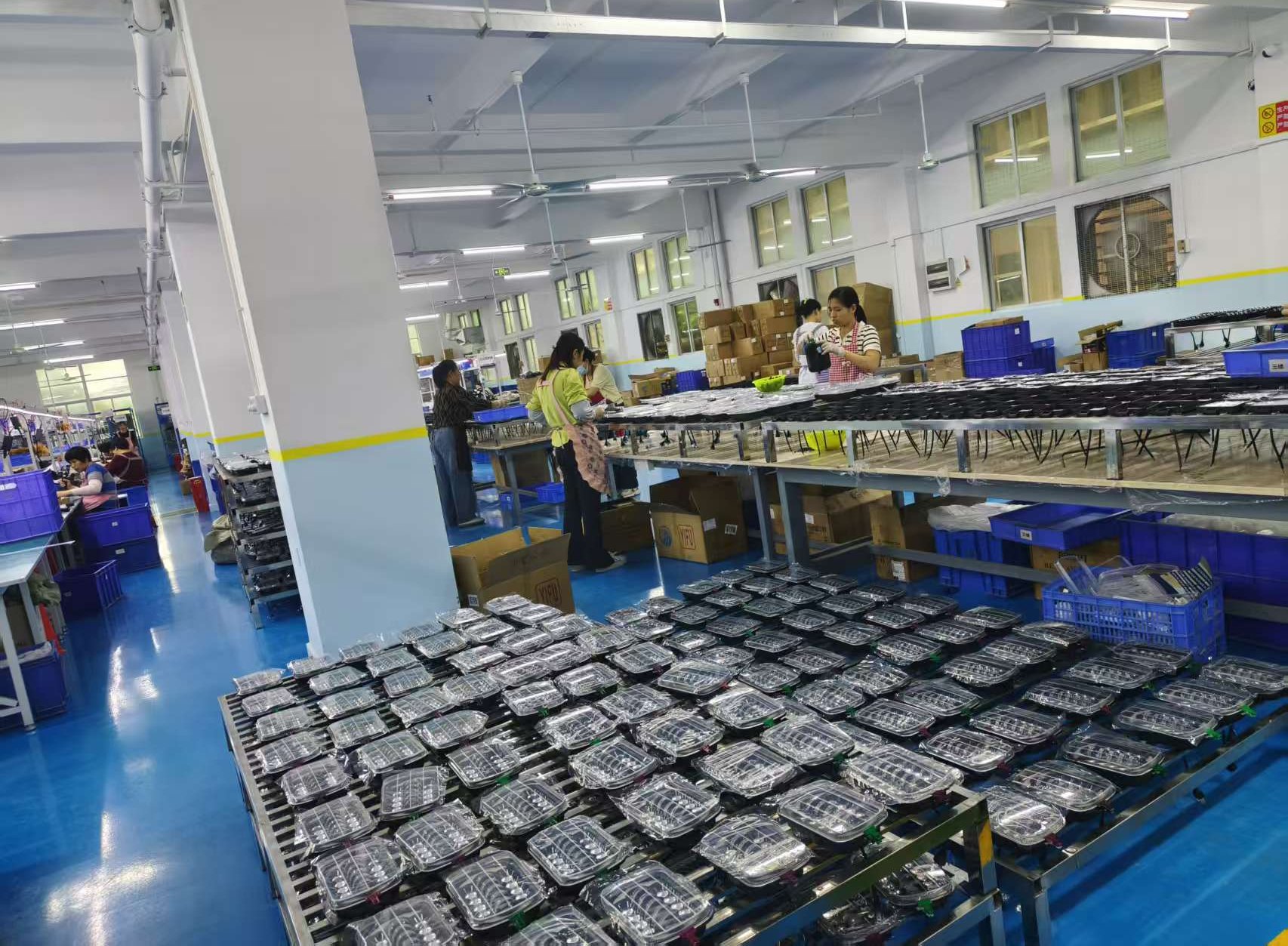
This produces the dividing line in Figure 2:
If only the label and packaging change, the factory’s existing approval still describes the product. Your tasks are commercial: confirm in writing that your brand will appear as a trade name on the approval (or accept that it will not, and understand what that means), and confirm that model numbers on the approval, the carton, the invoice and the moulded marking all reconcile. This is the same discipline as Check 3 of the verification guide.
If the lamp itself changes — different LED package, different optics, different driver, different housing — the previous approval no longer describes the product. The lamp must be re-tested for the changed characteristics and re-approved before it is placed on the market. Photometry, colour coordinates, EMC behaviour and sealing all can move when a component changes, which is why a changed lamp cannot simply inherit its ancestor’s documents. This is also why a supplier who says “we changed the LEDs but the approval is the same” has, in one sentence, described either a mistake or a misrepresentation.
The United States is different in kind. FMVSS 108 operates on self-certification: there is no government-issued certificate to inherit, and the party responsible for compliance is whoever manufactures or imports the vehicle equipment for the US market — which, for a private-label importer, means you. The implications are laid out in our FMVSS 108 guide; the short version is that relabelling does not transfer the responsibility to the factory unless the contract says so, and even then the market-facing obligation stays with the brand.
Cost and Time: Where the Money Actually Goes
Purchase price is the smallest and latest number in the comparison. The earlier numbers are one-off and structural, and they differ far more between modes than unit prices do.
| Cost item | Private label | ODM (configured) | OEM (your spec) |
|---|---|---|---|
| Tooling (housing, lens) | None | Rarely; shared platform | Buyer funds; recovers only at volume |
| Packaging artwork and plates | Low, one-off | Moderate, one-off | Full development |
| Testing and approval | None (existing type) | Possible extension or option test | Re-test of changed characteristics |
| Samples | Catalogue samples | Pre-production samples | Tooling trial (T1/T2) samples |
| Cash tied up before revenue | Lowest | Moderate | Highest, and slowest to recover |
| Ongoing commitments | None | Packaging stock | Tooling maintenance, spares, minimum runs |
Two practical readings of this table. First, the tooling line is where OEM decisions are really made: a housing tool pays for itself only across a volume you can estimate honestly, and it must be maintained, insured against the factory’s insolvency, and owned on paper by someone. Second, the approval line is where ODM decisions are really made: if your configuration changes photometry or EMC behaviour — a longer cable, a different connector, a tinted lens can all do it — ask which tests the factory will repeat before you assume the documents carry over.
Which Mode Fits Which Business
Strip away the terminology and the choice becomes a matching exercise between your commercial situation and the obligations in Table 2. Four situations cover most buyers we work with:
| Your situation | Default mode | Why it fits | First-order suggestion |
|---|---|---|---|
| Distributor or wholesaler, no own brand, many small accounts, need breadth and availability | Private label | The product is proven; your customers buy on stock and price; zero development risk | Start with catalogue bestsellers in your market’s voltage and colours |
| Own-brand e-commerce (store or marketplace), differentiation needed at listing level | Private label + own packaging | The customer cannot inspect the housing design; packaging, instructions and support carry the brand | A small range of proven lamps with your box, inserts and barcode |
| Fleet, bodybuilder or vehicle-maker supply; one customer, repeat volumes, tight specification | ODM, configured | The customer specifies voltage, connector, harness and mounting; the platform already exists | Configure an existing housing; agree the option list and its test implications in writing |
| Own brand with proven volume; competitors sell the same lamps; exclusivity now worth money | OEM or full custom | Only at this point does tooling plus testing plus a slower first cycle pay for itself | Fund tooling you own on paper; budget re-testing as a project cost, not a surprise |
The tie-breaker questions, when two modes both seem plausible: Can your customer perceive the difference you would pay for? Does your volume, honestly projected, recover tooling and testing within a planning horizon you would show a bank? And if the factory relationship ended next year, would you rather own a tool or own nothing? Three “no” answers mean the row above is your row.
OEM’s Four Hidden Costs
If the previous sections read as neutral, this one is deliberately not. For most small and mid-size buyers, moving to OEM is sold as an upgrade and experienced as a tuition fee. Four costs in particular rarely appear in the first quotation:
1. Tooling is a relationship, not a purchase. Moulds wear, springs fail, cavities corrode, and every production run moves the tool further from its as-new dimensions. Someone must maintain it, and whoever owns it controls whether your lamp can be made at all. A tool sitting in a factory that no longer answers your emails is a paper asset.
2. Every change re-opens testing. A component obsolescence, an LED update, a safety regulation revision — each one can turn into a re-test of a product only you sell. Owners of catalogue products share this cost across every customer of the platform; as an OEM, you carry it alone. See how one approval’s classes work for a sense of how granular re-testing gets.
3. Your capital learns to sit still. Tooling, packaging stock, higher minimums and slower first cycles all push cash into assets that cannot be redeployed. The same money in private-label inventory turns; in OEM tooling it waits.
4. Exclusivity is single-point dependency. The exclusivity you bought is only as durable as the supplier relationship, and the tool you funded may be legally yours while practically unreachable. Contract clauses help (next section); they do not make the dependency disappear.
The honest summary: OEM is the right answer when your volume is proven, your differentiation is real, and your customer will pay for what only you sell. When any of those three is missing, private label and configured ODM deliver the margin without the mortgage.
Seven Clauses That Decide Whether the Project Survives
Whatever mode you choose, the difference between a smooth multi-year programme and an expensive divorce is usually seven clauses. None of them is exotic; all of them are cheap to agree early and expensive to argue late.
| # | Clause | What it must say |
|---|---|---|
| 1 | Tooling ownership (title) | Who owns each tool, in which country’s legal terms, and your right to remove it on request — funding a tool does not automatically own it |
| 2 | Exclusivity scope | Territory, channel and duration — a worldwide perpetual exclusive is rarely granted and never should be assumed |
| 3 | Approval and trade name | Whether your brand is listed on the approval or covered by an extension, who files it, and who pays |
| 4 | Change control (ECN) | No change to components, suppliers or processes without written approval and, where relevant, re-sampling and re-testing |
| 5 | Discontinuation and spares | Notice period before a product ends, and a last-time-buy right for you and your service stock |
| 6 | Quality baseline | A sealed golden sample, the inspection standard applied, and what happens when a shipment fails it |
| 7 | Exit mechanics | Tool handover, remaining inventory, return or destruction of your drawings and brand assets |
Clause 4 deserves a story. A buyer orders a warning lamp for two years, reorders, and receives lamps that look identical but light differently — the factory substituted an LED package during a shortage, honestly believing it equivalent. No contract clause undoes a shipment; change control is what prevents it. The same discipline underlies the golden-sample practice in Check 7 of the verification guide.
Seven Mistakes We See Repeatedly
- Starting from the buzzword. Deciding “we want OEM” before writing down what must be different about the lamp. The specification decides the mode, not the other way round.
- Assuming the approval follows the lamp. The most expensive assumption in this trade, and the reason Section 3 exists.
- Paying for tooling without paper title. The money creates a moral claim, not a legal one.
- Treating “OEM” quotations as comparable. Two quotations can share a price and differ completely in what is being changed, tested and owned.
- Designing differentiation customers cannot see. A changed internal driver is invisible on a shelf; a changed mounting bracket is not.
- Ignoring the second order. First-order terms get negotiated for weeks; exclusivity, change control and exit clauses — the second-order terms — get signed unread.
- Confusing branding with product ownership. Your logo on a lamp everyone can buy is a marketing choice, which is fine — as long as it is priced and planned as one.
Frequently Asked Questions
Is OEM better quality than ODM or private label?
No. The mode describes who owns the design, not how well the lamp is made. A factory’s private-label bestseller is built on a mature, debugged platform with years of field history; a first-tooling OEM sample is a brand-new product with brand-new failure modes. Quality comes from the factory’s process control and the approval discipline behind the product — which you verify the same way in every mode.
Can I put my brand on a lamp the factory already sells to others?
Yes, and it is the most common arrangement in this trade — that is private label. Two things to settle first: whether your market’s customers could buy the identical lamp under another label (they can, at a different price), and whether your brand appears on the approval documentation. The lamp is legal either way; the branding strategy is yours to price.
Will my brand appear on the E-mark approval if I private-label a lamp?
Only if it is added. Approvals name the holder (the factory) and can list additional trade names; adding yours is a documented, usually modest administrative step that someone must actually file. Ask for it in writing before the order: either the approval will list your brand, or you accept in writing that the approval covers the factory’s trade name only.
We changed the LED. Can we keep the existing approval and markings?
No — not legally, and not safely. The approval describes a specific type; changing the light source changes the characteristics the approval attests to. The lamp needs re-testing of the affected characteristics and a new or amended approval before it is placed on the market, and the moulded marking must correspond to a valid approval for the product as built. Any supplier who suggests otherwise is handing you a compliance problem.
Who owns the tooling if I pay for it?
Whoever the contract says owns it — which is why the contract must say. In the absence of a clause, ownership typically stays with the party that possesses the tool, whatever you paid. The clause should state title, your right to inspect and remove the tool, and what happens to it when production ends or the relationship does.
What minimum order should I expect for OEM development?
High enough that the project only makes sense at volumes most first-time buyers do not have — which is the point of the decision. The honest way to size it is not to ask for a number but to build it: tooling recovery plus testing plus a reasonable production run, against a volume forecast you would defend to your accountant. A supplier who quotes an OEM minimum without seeing your specification is guessing.
Is ODM risky because the factory sells the same design to my competitors?
It is a pricing reality, not a defect. The design is the factory’s asset; exclusivity in any form costs money and volume. What you can negotiate is narrower: option exclusivity (a configuration only you order), market exclusivity for a term, or first access to new platform versions. Price those against what the same money would buy in product differentiation you own.
We are a small buyer. Is private label the only realistic option?
It is the right default, and calling it “only” undersells it. Private label on a proven platform gives you tested products, existing approvals, fast replenishment and none of the structural risks above — which is exactly what a small buyer needs to compete on availability and service. The mode you outgrow is not private label; it is the assumption that you cannot build a brand on it.
Working with JTPART
Working with JTPART
We are a supplier of LED lighting for trucks, trailers, buses and plant machinery — nine product families from warning and safety lamps to headlamps — and we are not a factory. That position shapes how we talk about this article’s subject: most of what we supply is private label and configured ODM from our partner factories, and we say so on the first email, because the model only works when the buyer knows exactly which column they are in.
Concretely: we will tell you for any quoted lamp whether it is a catalogue product or a configuration, what can be changed without touching the approval, what would trigger re-testing, and who holds each document. For options beyond that — new tooling, exclusive configurations, brand extensions on approvals — we will tell you honestly what it involves before you spend a deposit, and we do not publish prices because the honest number depends on your specification, quantity and terms.
Tell us which column you are in → or browse the range first: warning & safety lamps, work lights, light bars, headlamps and tail lamps.