After enough enquiries, the pattern stops being a pattern and becomes a list. Truck light buyers do not report fifty different failures — they report the same ten, in the same order, at the same stages of the same purchase. Almost none of them are caused by bad intentions. They are caused by four process gaps that sit on the buyer’s side of the table as often as the supplier’s.
This article is the honest one in our series: the problems our own customers and enquiries bring to us most often, why each one happens, what we do about it — and, just as important, how to check any supplier on the same points, including us. It is written for the distributor, the fleet buyer and the private-label seller who has been through at least one disappointing shipment and wants the next one to be boring. If you are new to sourcing, start with the sourcing guide and come back here before you place a first order.
Why the Same Problems Repeat
Here is the observation that took us longest to learn: buyers who change suppliers after a bad experience usually have the same experience again. Not because all suppliers are the same — they are not — but because the cause of the failure was rarely the factory alone. It was a gap in the process, and the process travels with the buyer. Four gaps produce almost everything:
Read the four causes again and notice that none of them is “poor quality”. Quality failures are what the four gaps produce; the gaps themselves are ordinary commercial arrangements that were never written down. That is good news, because documents are cheaper than defects and easier to demand than trust.
Where in the Journey Things Go Wrong
Map the ten complaints onto the eight stages of a purchase and the clustering is obvious. The expensive mistakes are made early (who you ask, what you specify) and become visible late (what arrives, what fails):
| Stage | What usually goes wrong | The document that prevents it |
|---|---|---|
| Search & shortlist | Comparing brochures instead of specifications | A written RFQ with your twelve fields (see the cost breakdown) |
| Enquiry | Prices that cannot be compared because specifications differ | Aligned quotations on one grid |
| Sampling | Hand-built samples that production cannot reproduce | A pre-production sample from a trial batch |
| Order | Terms that change after the deposit | Frozen specification, signed and versioned |
| Production | Quiet delays and silent substitutions | Photo checkpoints at agreed milestones |
| Shipment | Damage, shortages, paper that does not match goods | Pre-shipment inspection report and packing list |
| Installation | Fit, voltage and CAN-bus surprises | Vehicle application list confirmed in writing |
| After-sales | Claims with no agreed definition of failure | Claim terms settled before the order, not after |
The rest of this article takes the ten complaints one at a time. For each: what buyers actually tell us, why it happens, what we do about it, and the question that checks any supplier on the same point — because a claim you cannot verify is just better marketing.
Ten Problems, and What We Do About Them
1. “The sample was perfect. The container was not.”
What buyers tell us. The approval sample earned the order; the shipment does not look like it. Lenses slightly greyer, cables thinner, packaging lighter. Nothing catastrophically wrong — just not the thing that was approved.
Why it happens. Because the sample was never a production unit. Engineering samples are hand-built, often from selected parts, by the people who designed the lamp. Production is built by a line, at speed, from current material batches. The gap between those two things is normal and universal; the failure is not measuring it.
What we do. We separate the two sample types by name. The engineering sample proves the design; the pre-production sample — pulled at random from a trial batch on the actual line — is the only one that counts for approval. It is photographed, numbered and signed, and two are retained: one with us, one with the factory. First article from mass production is checked against that numbered sample before the batch proceeds.
How to check any supplier. Ask: “Is this sample hand-built or from a trial batch? What is its number, and where are the retained copies?” A factory with a process answers in a sentence. One without answers with enthusiasm.

2. Batch two does not match batch one
What buyers tell us. The first order sold well. The repeat order looks different — a colder white, a dimmer output, a slightly different housing casting. Customers notice before the buyer does.
Why it happens. LED flux is sorted into bins, and factories buy chips by availability as often as by bin. A repeat order placed eight months later can land on a different bin, a different driver revision or a modified housing mould, all invisible on a purchase order that just says the model number.
What we do. The frozen specification carries the LED part number and bin code, the driver schematic revision and the housing drawing version — and the golden sample is referenced by number on every purchase order. If a component must change (end-of-life parts are real), we say so before production, not after shipment, and we state what changed and why.
How to check any supplier. Ask what happens when a component becomes unavailable. A serious answer names a change-control step; a casual one names “equivalent quality”, which is not a specification.
3. The certificate does not match the lamp
What buyers tell us. An E-mark is moulded into the lens, a certificate arrives with the shipment, and somebody at the border — or worse, an inspector after a roadside check — notices the certificate describes a different lamp.
Why it happens. Approvals are granted per configuration, and certificates get reused across product families that look similar. Sometimes it is carelessness; sometimes it is the factory’s honest belief that “basically the same lamp” is covered; occasionally it is fraud. The buyer’s exposure is identical in all three cases.
What we do. We name the approval holder, provide the certificate and the tested configuration it describes, and confirm in writing which configuration your order matches — before the deposit. Where a customer’s market needs a marking variant, we check with the approval holder first rather than assuming the mark transfers. Our E-mark guide shows what to look for on the lens itself.
How to check any supplier. Ask for the certificate and the photographs of the tested article. Ten minutes with those two documents answers the question the border will ask later.
4. The lumens were not what the brochure said
What buyers tell us. The listing said 4,000 lumens; the lamp beside a known reference delivers noticeably less. Nobody can prove anything, but the returns say what the datasheet did not.
Why it happens. Chip lumens quoted as lamp lumens. A raw LED output measured at the chip, at 25°C, with no optic, driver loss or thermal derating, becomes a round marketing number that the finished lamp cannot reach at operating temperature. We explained the whole chain in the cost breakdown.
What we do. We quote delivered lumens from integral-sphere tests on the finished lamp, at operating temperature, and we state the test condition. Where a customer needs a number for their own listing, we give them the measured one and the method — a number you can defend is worth more than a bigger one you cannot.
How to check any supplier. Ask for the test report on the lamp, not the chip, and ask at what temperature it was measured. The report either exists or it does not.
5. Half the shipment arrived damaged
What buyers tell us. Crushed cartons, cracked lenses, bent brackets — and an argument about whether it happened in the factory, the port or the truck.
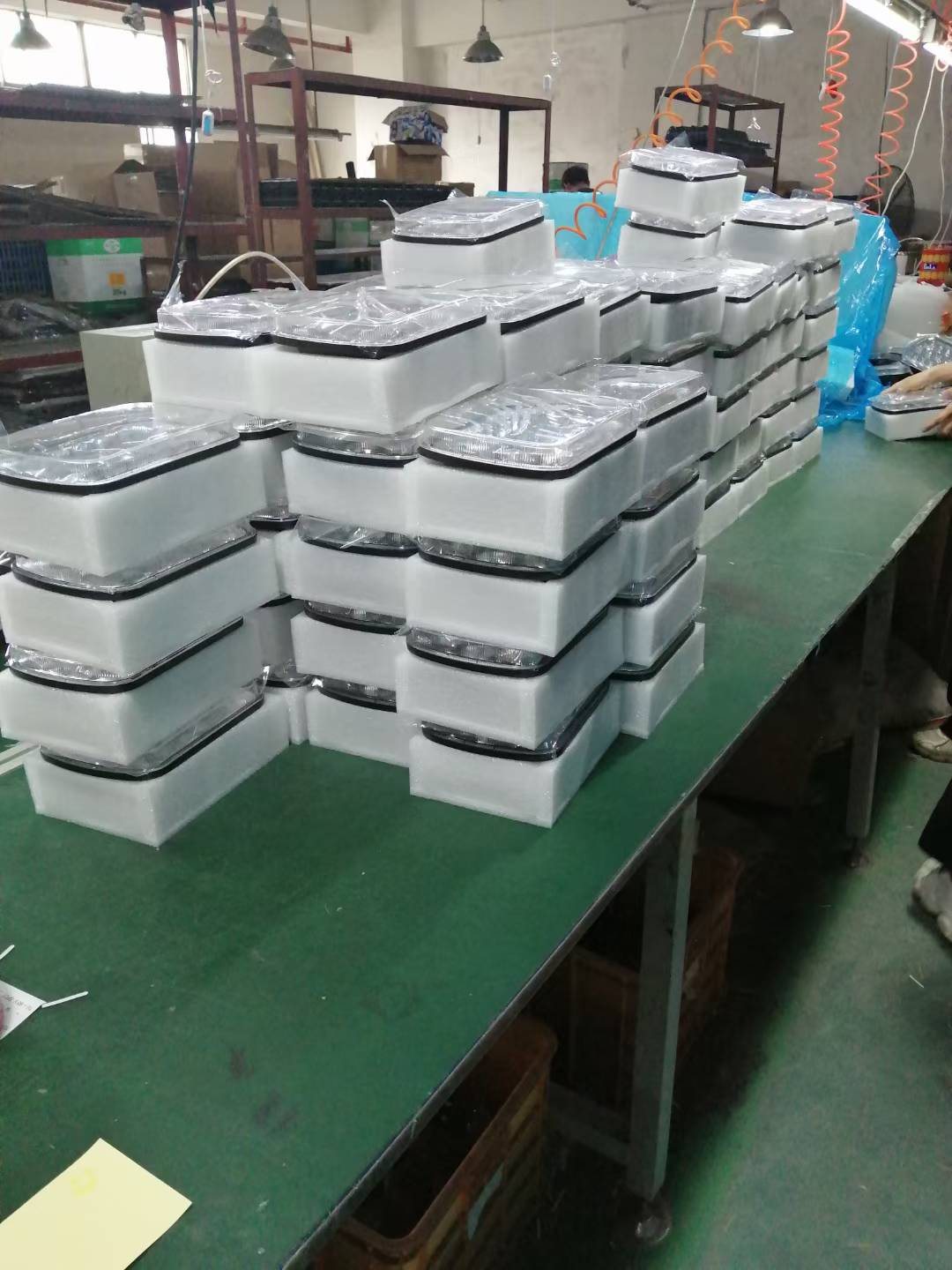
Why it happens. Lamps ship assembled and stacked; a single-wall carton without formed inserts survives a warehouse and fails a container. Sea freight adds thirty days of humidity and vibration that nobody budgets for. The cheapest place in the entire bill of materials to save money is packaging, and it is the only place where the buyer pays 100% of the saving.
What we do. Packaging is part of the specification, not an afterthought: drop-tested cartons, formed inserts for assembled lamps, desiccant for sea containers, and cartons photographed packed on the pallet before the container closes. Damage claims then have evidence on both sides, which is how they get settled instead of argued.
How to check any supplier. Ask what the carton survived in testing, and ask to see photos of a packed pallet from a previous order. Both are normal requests.
6. The lead time kept moving
What buyers tell us. Thirty days confirmed, forty-five delivered, and the first news of the slip arrived on day thirty-one — or never.
Why it happens. Lead time is quoted at order confirmation, before material purchasing, and slips for ordinary reasons: a chip allocation, a housing casting queue, a public holiday that reshuffles the line. The failure is not the slip; it is that nobody reports it, because nobody was asked to and nobody is measuring.
What we do. We quote lead time with its assumptions stated — material lead time, production window, shipping frequency — and we report at fixed milestones regardless of whether there is news. A quiet week gets a photo anyway. Buyers do not need factories to never slip; they need to know on day five, not day thirty-five, because a schedule you can replan is a schedule.
How to check any supplier. Ask what their milestone reporting looks like on a normal order. Vagueness here predicts the exact problem you are asking about.
7. The MOQ forced stock we could not sell
What buyers tell us. The minimum order made sense for the factory and not for the market: eighteen months of one SKU, none of three others, and cash converted into shelf clutter.
Why it happens. MOQ exists for honest reasons — packaging runs, mould cycles, colour changes — but it is quoted as one number per SKU instead of being designed around the buyer’s actual assortment. We covered the mechanics in the MOQ guide.
What we do. We quote the minimum that the assortment needs, not the number that one SKU prefers: mixed SKUs inside an order where the factory’s constraints allow it, a smaller first run as a field trial, and an honest “this SKU does not make sense below X” where that is the truth. We would rather have the repeat order than the oversized first one, and we say so.
How to check any supplier. Ask for a first-order proposal sized to your market, not their machinery. The shape of the answer tells you who the order was designed for.
8. It would not fit, or it threw errors
What buyers tell us. Bracket half a centimetre off, plug that does not mate, dashboard warning after fitting, indicators that hyperflash, or a lamp that simply stays dark on a vehicle it was sold for.
Why it happens. “Fits trucks” is not a specification. Voltage range, polarity protection, CAN-bus behaviour with low-current LED loads, flasher load mismatch, bracket geometry and connector type are six separate facts, and a buyer who does not state them gets whatever the factory assumed. Some of the fixes are electrical and have their own coverage in this series — EMC interference, ingress protection, US self-certification — but the sourcing fix is simpler: state the application.
What we do. Before quotation we ask for the vehicle list and the electrical environment, and we confirm in writing what each model is sold for: voltage range, polarity protection, CAN-bus compatibility where relevant, connector and bracket drawings. Where a lamp needs a load resistor or a CAN-specific driver to behave on a customer’s vehicles, that is decided at the sample stage, not discovered in the workshop.
How to check any supplier. Send them your hardest vehicle — the oldest, the strangest voltage, the fussiest body control module — and see whether the reply asks questions or just says yes.
9. The claim went nowhere
What buyers tell us. Twelve failed units, photographs sent, and then silence, or a reply that reclassifies the failure as installation damage and closes the file.
Why it happens. Because the warranty was a sentence on a quotation, not a document with definitions. What counts as a failure, what evidence is required, who pays freight, what the remedy is, over what period — none of it was agreed while both sides still wanted the deal. Every warranty argument is easier when it was drafted before the order.
What we do. Claim terms travel with the quotation: what a failure is, what evidence we need (photographs, quantities, the batch code moulded into the housing), what the remedy is, and whose freight it is in each scenario. When a claim arrives, it is assessed against those terms in writing — we aim to give a first assessment within two working days of receiving the evidence — and the batch code lets us trace the units to a production run rather than argue about a model number. A claim we cannot reproduce from the batch is investigated as information, not dismissed as weather.
How to check any supplier. Ask for their claim terms before asking for their price. Suppliers who have them send them; suppliers who do not will explain that you can trust them.
10. We could never get a straight answer
What buyers tell us. Three contacts, contradictory replies, technical questions answered with prices and prices answered with brochures. The relationship consumed more hours than the shipment was worth.
Why it happens. In a factory, your questions travel through sales, engineering and production as foreign languages. Without one person who owns the answer, the buyer receives whatever each department replied with first. Time zones make it worse; being nice about it makes it slower.
What we do. One named contact owns every question, in writing, with the technical files behind them — drawings, test reports, certificates, photographs. Questions that need the factory get asked to the factory and answered with documents, not summaries. We would rather say “we do not know, we will find out by Thursday” than send a confident wrong answer; buyers forgive the first and never forgive the second.
How to check any supplier. Ask one technical question, one commercial question and one document question in a single email. The structure of the reply — who signs it, whether documents attach — is the answer.
The Seven Control Points Behind Those Answers
Everything above reduces to seven points where a purchase can be stopped and checked, each producing a document. This is the whole machinery; it fits on one diagram:
| Gate | Output you should be able to hold | What it prevents |
|---|---|---|
| 1. Spec sheet | Every parameter stated in writing, nothing left to assumption | Quotations that cannot be compared |
| 2. Frozen spec | Signed, dated, versioned specification + PO reference | Silent changes between batches |
| 3. Golden sample | Numbered sample cards, two retained copies | Sample-to-production drift |
| 4. First article | First-article check against the golden sample | Batch one approved in the abstract |
| 5. In-process photos | Photos at agreed milestones, news or not | Quiet delays and substitutions |
| 6. Pre-shipment | Count, function test, packed-pallet photos, packing list | Shortages, damage, paper mismatches |
| 7. Claim terms | Written failure definitions and remedies, batch traceability | Claims that dissolve into argument |
Two things are worth noticing about this list. First, nothing on it requires trust, a factory visit or a third-party auditor — though for first orders we recommend inspection anyway, as the seven-check guide explains. Second, every document is yours: the spec, the sample card, the reports and the claim terms stay valid if you move to a different factory, which is precisely what makes changing suppliers cheap instead of terrifying.
What We Do Not Do
Honest boundaries, because the fastest way to lose a buyer is to win them with capabilities that do not exist. We are a supplier, not a factory: the lamps are manufactured by our partner factories, and the approvals sit with those factories — we orchestrate, verify and take responsibility for the arrangement, and we say so in the first email. We do not promise zero defects; a process reduces them and makes them traceable, and any supplier who promises you none is describing a factory they have never run. We do not publish prices, because a price without your specification, quantity and destination is a number with no meaning. And we will sometimes tell you not to buy: the cheapest honest sentence in this trade is “that SKU does not make sense for your market yet”, and we mean it, because a customer who grows is worth more than an order that dies in a warehouse.
If You Are Not Buying From Us: Twelve Questions That Work Anyway
Every point in this article converts to a question, and none of them depends on us. Before your next deposit, ask:
- Is the sample hand-built or from a trial batch, and where are the retained copies?
- What are the LED part number and bin code, and where are they recorded?
- Which approval covers this exact configuration, and who holds it?
- Are the quoted lumens measured on the lamp, at what temperature?
- What did the carton survive in testing, and can I see a packed pallet?
- What gets reported during production, at which milestones, even when nothing changes?
- What happens when a component goes end-of-life mid-relationship?
- Can the first order be sized to my market rather than your machinery?
- What is the claim definition, the evidence required, and who pays which freight?
- Can you trace a failed unit to a production batch by its marking?
- Who owns my questions, and can they attach documents rather than summaries?
- Which of these twelve can you put in writing today?
Question twelve is the important one. A supplier who answers ten of these well but will not write them down has a process; a supplier who writes them down has a process and intends to keep it.
Frequently Asked Questions
What is the most common problem when buying truck lights from China?
By volume of complaints, the top three are: samples that mass production does not reproduce, lumens quoted from the LED chip rather than the finished lamp, and claims that dissolve because nobody defined a failure in writing. All three are process gaps rather than quality gaps, and all three are preventable with documents agreed before the deposit — which is what most of this article is about.
How do I make sure the sample matches what I will actually receive?
Insist on a pre-production sample pulled from a trial batch on the production line, not a hand-built engineering sample. Have it photographed, numbered and signed, retain two copies, and reference its number on the purchase order with a first-article check before the batch proceeds. This is standard practice at any factory that runs one; if a supplier cannot do it, the factory does not have a sampling process to rely on.
Who pays when goods arrive damaged?
Whoever the claim terms say pays, which is why the terms must exist before the order. In practice: damage visible at the port or with the container sealed is a carrier and insurance matter; damage from inadequate packaging is the supplier’s; damage from a specification the buyer approved is the buyer’s. Photographs of the packed pallet before the container closes are what make these three scenarios distinguishable instead of arguable.
What should a truck light warranty actually cover?
At minimum: a definition of failure (what counts — and what does not, such as misuse or unauthorized repair), the evidence required (photographs, quantities, the batch code), the remedy (replacement, credit or repair), whose freight in each scenario, and the period. A warranty that excludes “labour and shipping” is shorter than its number suggests, because labour and shipping are most of what a claim costs a fleet.
How can I check a supplier before paying a deposit?
Documents, in this order: business licence and export history, the approval certificates with the tested configurations, test reports for IP and EMC, a written specification for the exact product, claim terms, and references you can contact. Our seven-check guide sequences it; the short version is that every check is a document request, and every document is either produced or it is not.
Why do lead times slip even after confirmation?
Because the confirmed number is a plan, and plans meet material allocations, casting queues and holidays. Slippage itself is normal and mostly harmless; the damage comes from late discovery. Ask suppliers to report at fixed milestones with photographs regardless of news, and replan on day five instead of day thirty-five — a schedule that gets reported is a schedule you can work with.
What information should I give a supplier to avoid compatibility problems?
The vehicle list with years, the voltage environment (12V/24V and real-world range), connector types and pinouts where you know them, bracket constraints, and the electrical behaviours that matter to you — CAN-bus sensitivity, flasher load, polarity risks. The more of this that is in the specification, the less of it is a guess. Suppliers who ask for this unprompted are the ones worth shortlisting.
Do these problems happen with European suppliers too?
Yes — the four root causes are not geographic. What differs is the default paper: established European suppliers usually produce specifications, first-article reports and claim terms without being asked, because their customers demand them. The practical lesson is not “buy European” but “demand the same paper from whoever you buy from”, which is exactly the twelve questions in this article.
Working with JTPART
We are a supplier of LED lighting for trucks, trailers, buses and plant machinery — nine product families from warning and safety lamps to headlamps — and we are not a factory. The manufacturing and the approvals sit with our partner factories; what we own is the process this article describes: the specification, the frozen version, the numbered samples, the milestones, the pre-shipment evidence and the claim terms. When something goes wrong — and across enough shipments something eventually does — the process is what turns an argument into a fix.
If you bring us a problem from a previous supplier, it is genuinely useful: tell us which of the ten it was, and we will show you the gate that prevents it before you spend anything. If you just want the range to start from, it is here: warning & safety lamps, work lights, light bars, tail lamps, marker lamps and headlamps.
Tell us which problem cost you most → and we will show you the gate that prevents it.