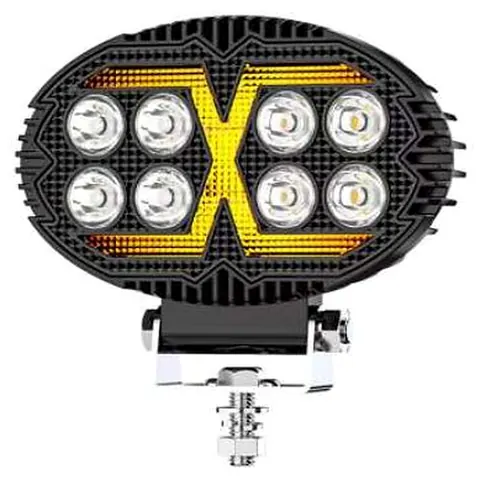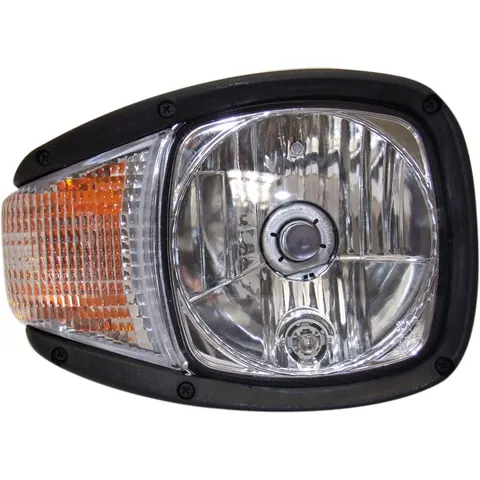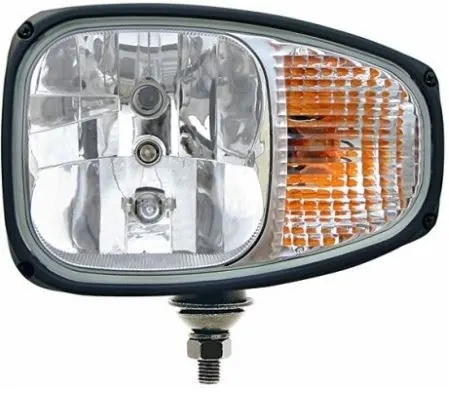
After the fourth enquiry in a month about a loader headlamp, the questions stop being random and become a list. Does it fit the aperture? Will it bolt up? Will it run on the machine's voltage? Does it switch the functions the operator actually uses? Almost every fitment complaint we see traces back to one of those four checks being skipped at order time.
This article walks through the four fitment checks in the order a buyer should run them, using a real replacement headlamp built for the LiuGong CLG850H wheel loader as a worked example. It is written for the distributor, the fleet maintenance buyer and the parts exporter who needs a lamp to fit the first time — not after a return shipment. Every number quoted from the lamp comes from its datasheet and dimensional drawing, which we publish with the model.
1. Why wheel loader headlamps get replaced
Three situations drive almost every replacement order. First, the original halogen unit has degraded: reflector coatings fade, seals age, and light output drops until night shifts become unsafe. Second, the lamp has been damaged — loaders work with their front face close to stockpiles, walls and truck beds, and the headlamp position takes most of the impacts. Third, owners upgrade: LED replacements cut current draw, remove a recurring bulb-replacement cost, and hold their output through long shifts.
Chinese 5-ton wheel loaders are one of the highest-volume equipment categories in the world, and they are exported in large numbers to markets where local dealer parts supply can be slow. That is why a large share of replacement-lamp demand moves through export and aftermarket channels rather than dealer networks — and why fitment mistakes made at order time are expensive to discover at installation time. Owner communities confirm how common the upgrade path is: LiuGong 850H owners document adding LED driving lamps to the factory positions on machines they run daily (see Sources).

2. The worked example: LiuGong CLG850H
This guide uses a lamp built for the LiuGong CLG850H as its worked example, because the machine is well documented and widely exported. Public specification listings describe the CLG850H as a 5-ton-class wheel loader: rated load 5,000 kg, operating weight around 16,500 kg, rated power 162 kW, with a standard bucket around 2.7 m³ (see Sources for the listing referenced). The machine is produced by Guangxi LiuGong Machinery Co., Ltd.
Do not confuse two model names. LiuGong builds the CLG850H; Lonking, a different manufacturer, builds an LG850H with similar tonnage. Search results mix the two constantly. Before ordering any lamp “for an 850H”, confirm the machine's manufacturer and nameplate, then match the drawing.
Why does machine class matter for the lamp? Because a 5-ton loader's electrical system, front aperture and vibration profile sit in a known range. The lamp in this example was built around those constraints — the next four sections read its datasheet line by line.
3. Fitment check 1: housing size and aperture
The first question is geometric: does the lamp body fit the opening on the machine, or the position left by the lamp you are replacing? The worked example's housing measures 238 × 154 × 131 mm, with a net weight of 1,609 g (JT datasheet, model HEAD-024). A buyer with a CLG850H, or with the worn lamp in hand, compares those numbers against the aperture before reading anything else on the page.
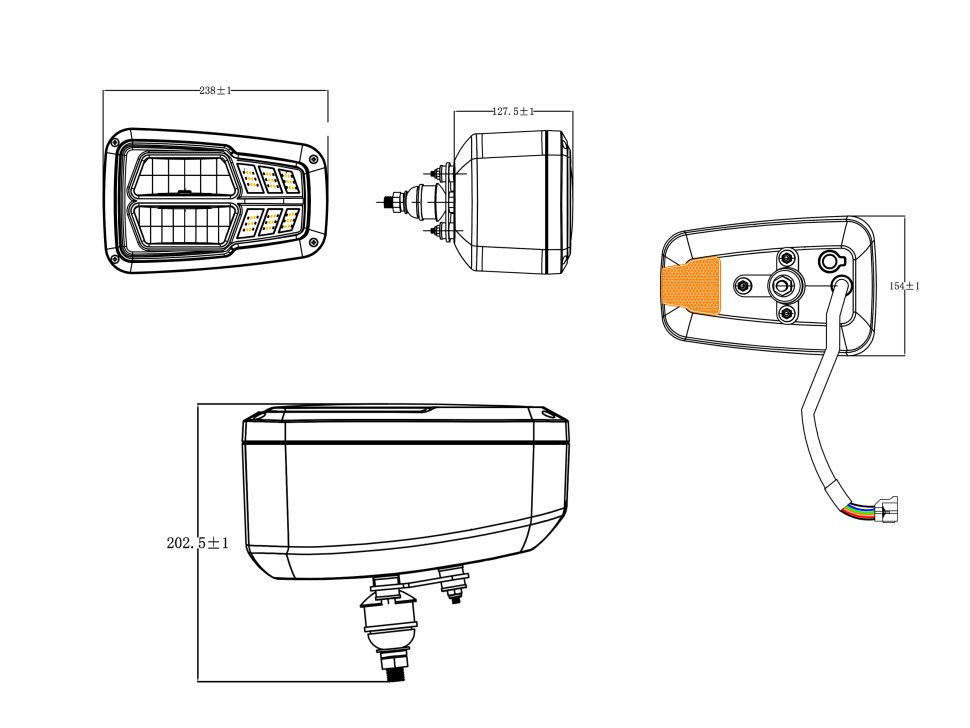
One caution: summary dimensions and the drawing can differ, because the drawing usually includes the bracket, stud and cable exit that the summary omits. In this example the summary depth is 131 mm while the drawing's side depth is 202.5 mm once the mounting bracket is included. Both numbers are correct; they measure different things. Ask which one describes your clearance.
4. Fitment check 2: the mounting pattern
Size tells you whether the lamp can enter the aperture; the mounting pattern tells you whether it can be bolted down. The worked example mounts on a single M12 stud through the rear face, with a nut and bracket taking the clamp load (JT datasheet: mounting size M12). A single-stud mount is quick to fit and allows rotation for aim adjustment, which is why many OE and aftermarket front lamps use it — but it also means the lamp's rear face must be flat against the mounting surface and the stud position must align with the machine's hole.
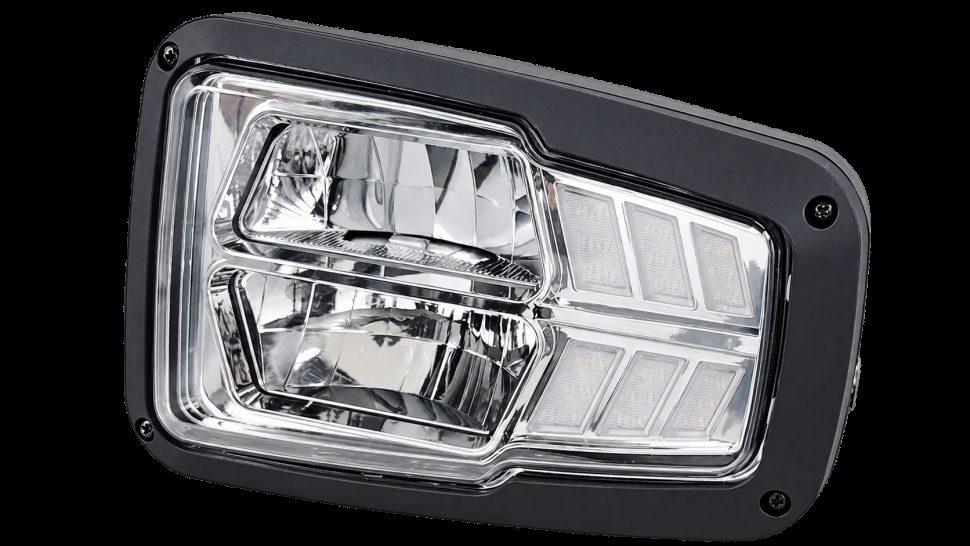
Before ordering, compare three positions on the drawing: the stud diameter (M12 here), the spacing between the mounting face and any brace points, and the direction in which the cable exits. A lamp that bolts up but exits its cable into the machine's bracket is a return shipment, not an installation. If your machine runs a different combination lamp with the indicator built in, the mounting logic is the same — see the 5-pin headlamp and indicator combination for how that version packages the functions.
5. Fitment check 3: voltage system
Most wheel loaders in this class run a 24 V electrical system. A lamp rated 12–36 V (JT datasheet, model HEAD-024) accepts that nominal voltage with room on both sides — and the room matters. Cold starts pull the system voltage down; alternator load dumps push it up; some machines in mixed fleets are converted between 12 V and 24 V configurations. A wide-range lamp covers all of it without a separate converter, and lets one part number serve several machines in a fleet.
The buyer's check is simple: read the machine's nominal voltage, then confirm the lamp's stated range includes it, then confirm the connector. Voltage range without a compatible connector is still an unusable lamp.
6. Fitment check 4: beam functions
A front lamp package on a loader usually has to do more than one job. The worked example combines dual reflector sections — a higher and a lower optic for the driving beams — with LED strips on each side that work as position lights and give the machine a defined daytime signature (JT datasheet and product images, model HEAD-024). When you compare lamps, list the functions your machine actually switches: high beam, low beam, position light, and in some markets a turn function carried by a separate lamp. A replacement that delivers fewer functions than the lamp it replaces leaves a switched circuit dead on the dash.
Light output claims are the hardest numbers to verify from a datasheet alone. Where a supplier quotes raw lumen figures, ask what they were measured from; where they quote beam distance, ask for the test setup. Our beam pattern guide explains how to read a distribution before you commit to an order.

7. What the datasheet does not tell you
A dimensional datasheet answers fitment. It does not answer durability. Before a buyer treats a datasheet as a full specification, the following remain open questions, and we recommend asking each one explicitly — of any supplier, including us:
- Ingress protection. Which IP rating was the lamp tested to, and does the record cover the connector and cable entry or only the housing? Our IP67 vs IP68 vs IP69K guide explains what the numbers actually test.
- Vibration and shock. A stud-mounted lamp on a loader bucket line sees constant shock loading. Ask what vibration testing exists for the exact model.
- Housing material. The worked example uses a plastics housing (JT datasheet). Plastics save weight and resist corrosion; buyers running in high-heat or high-impact environments should ask about material grade and wall thickness before assuming it matches their duty cycle.
- Approvals. Off-highway lamps are not always covered by road-vehicle approvals such as ECE or DOT, but some destination markets and some fleet purchasers require specific documents anyway. Confirm what the destination market requires rather than assuming — our ECE R10 EMC guide covers the interference side, and the certification guide maps approvals to markets.
- Electromagnetic compatibility. LED drivers can interfere with machine radios and CAN systems. The ECE R10 guide above covers what to ask.
8. The worked example's datasheet in full
Assembled from the JT datasheet for model HEAD-024, the specification a buyer would check against the four fitment points above:
| Field | Value (JT datasheet, model HEAD-024) |
|---|---|
| Reference application | LiuGong 850H wheel loader (front position) |
| Housing | Plastics |
| Dimensions | 238 × 154 × 131 mm |
| Mounting | M12 stud |
| Voltage | 12–36 V |
| Net weight | 1,609 g |
The dimensional drawing in section 3 supplements this table with the bracket-inclusive depths and the cable-exit position. We publish model-level fields only where the documents exist; the drawing above is part of the model file.
9. Where lamps like this are used
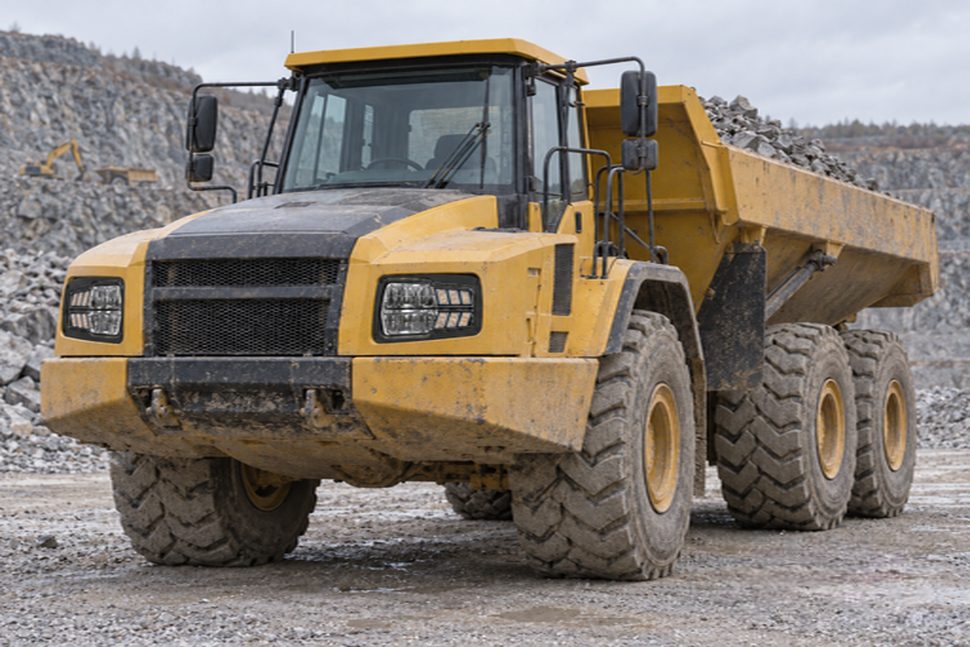
The four fitment checks are not specific to one machine brand. Front-facing lamp packages with similar apertures and stud mounts appear across the off-highway fleet — and the same replacement logic applies whether the machine carries a dedicated headlamp or a combined lamp such as the LED headlamp assembly with position indicators used on telehandlers and dumpers.


10. The documents to request before ordering
- The dimensional drawing, including mounting points, stud size and cable-exit position.
- The stated voltage range and the connector type fitted.
- The beam-function list: what switches exist and what each does.
- The ingress protection rating and its test record, including which assembly was tested.
- Any vibration or endurance test reports for the exact model.
- Approval certificates required in the destination market, if any.
- A sample, where the order volume justifies one, before committing to production quantities.
JT's supplier verification checklist covers the wider checks around the factory, and the headlight selection guide covers the road-truck side of the same decision.
11. Short questions
Will a headlamp designed for a LiuGong CLG850H fit other wheel loaders?
Only if the housing dimensions and the mounting pattern match. A lamp built around a 238 × 154 mm aperture and an M12 single-stud bracket can suit several machines, but the buyer should compare the mounting-point drawing, not the model name, before ordering.
Is a 12–36 V lamp safe to use on a 24 V loader?
A 24 V loader sits inside a 12–36 V window, and the wide range also absorbs voltage spikes from cold starts and alternator load dumps. The buyer should still confirm the connector type and the machine's charging behaviour before fitting.
Which documents should I request before ordering replacement headlamps?
Ask for the dimensional drawing with mounting points, the stated voltage range, the beam-function description, the ingress protection rating and its test record, and any approval certificates required in the destination market.
Sources
- 第一工程机械网 (d1cm). 柳帅CLG850H轮式装载机. m.d1cm.com/dealer/1002118/liugong002/116845. Listing states rated load 5,000 kg, operating weight 16,500 kg, rated power 162 kW, bucket capacity 2.7 m³, manufacturer Guangxi LiuGong Machinery Co., Ltd.
- 铁甲帅程机械网 (cehome). 城门失火殠及鱼鱼——柳帅850H维饼记. m.cehome.com/bbs/thread/info/1425823. Owner documentation of fitting LED driving lamps to a LiuGong 850H, including factory-provided mounting positions.
- JT. HEAD-024 datasheet and dimensional drawing. Values quoted in sections 3–8: housing plastics, 238×154×131 mm, M12 mount, 12–36 V, 1,609 g, reference application LiuGong 850H.
Send us the machine model and lamp position → we will confirm fitment against the drawing and voltage before we quote.