Ask why a Chinese work light costs a quarter of the European shelf price and you will get one of two answers. From the factory: “lower labour costs.” From the competitor’s salesman: “they cut corners.” Both are mostly wrong. The price difference is a map of nine or ten separate blocks — and the single largest one has nothing to do with how the lamp is made, or who made it.
This is the sixth piece in our sourcing series. The last guide covered the commercial terms of an order; this one goes inside the number itself. It is written for the distributor who has to defend a margin to a customer, the fleet buyer who has been told that cheap lamps are a false economy, and the importer who wants to know exactly which corners can be cut safely — and which ones transfer the cost onto their own warranty department.
Same Lamp, Four Prices
Start with the journey, because it explains most of the gap before we discuss a single component. Below is a price build-up for one 1,000-lumen LED work light — the kind that bolts to a truck’s headache rack — from a factory gate in China to a retail shelf in Europe, sold the conventional way through an importer and a distributor:
| Stage | Adds | What the money pays for | Can you influence it? |
|---|---|---|---|
| Factory price, FOB China | $10.00 | Materials, assembly labour, factory overhead and margin | Yes — the only block a purchase order directly touches |
| Freight and insurance | $1.10 | Sea freight share in a mixed container, marine cover | Partly — consolidation, container terms, season |
| Duty and clearance | $1.30 | Import duty on the HS code, broker fees, port handling | Partly — correct classification, incoterms, customs regime |
| Importer overhead and margin | $11.60 | Warehouse, sales staff, warranty reserve, profit | Yes — buy direct and this block becomes your workload |
| Distributor margin | $8.00 | Stocking risk, credit terms, rep commissions | Yes — order size and order consistency |
| Retailer margin | $10.00 | Shelf space, staff, returns | No — not your layer |
Read that table again and notice which row is smallest. The factory captures about a quarter of the final price, and everything it spends — chips, drivers, aluminium, labour, its own profit — lives inside that quarter. The other three quarters are the cost of distance: moving the lamp, clearing it, warehousing it, selling it, and financing it while all of that happens. So the first and most important thing to understand is that “cheap Chinese lights” is mostly a statement about distribution, not about manufacturing. A European workshop buying from a national distributor is not comparing its lamp to a Chinese factory price; it is comparing it to a factory price plus three businesses’ entire cost structures.
This is also why the gap survives everything. Freight rates quadrupled in the container crisis and the shelf price barely moved, because freight was one dollar ten of a forty-two-dollar lamp. When people say Chinese lamps got cheaper over the last decade, they usually mean the channel compressed — importers started buying direct, marketplaces let retailers skip a layer — far more than they mean anything changed on the factory floor.
Six Structural Reasons, None of Them Sinister
Within that factory price, there are real reasons a Chinese lamp costs what it costs. Six of them are structural — they would apply to any lamp made anywhere under the same conditions, and none of them involves lowering the specification.
1. Scale: one mould, tens of thousands of pieces
A work light that sells ten thousand units a year amortises its housing mould, its lens tool, its testing and its engineering hours across ten thousand lamps. A European niche manufacturer selling eight hundred of the same lamp a year must recover the same fixed costs across eight hundred. That difference alone can double the unit price before anyone buys a single LED, and it is the reason the European factories that remain competitive almost always make something else as well — complete vehicle systems, OEM contracts, military or agricultural lines — that shares their tooling overhead.
2. The cluster: everything within an hour’s drive
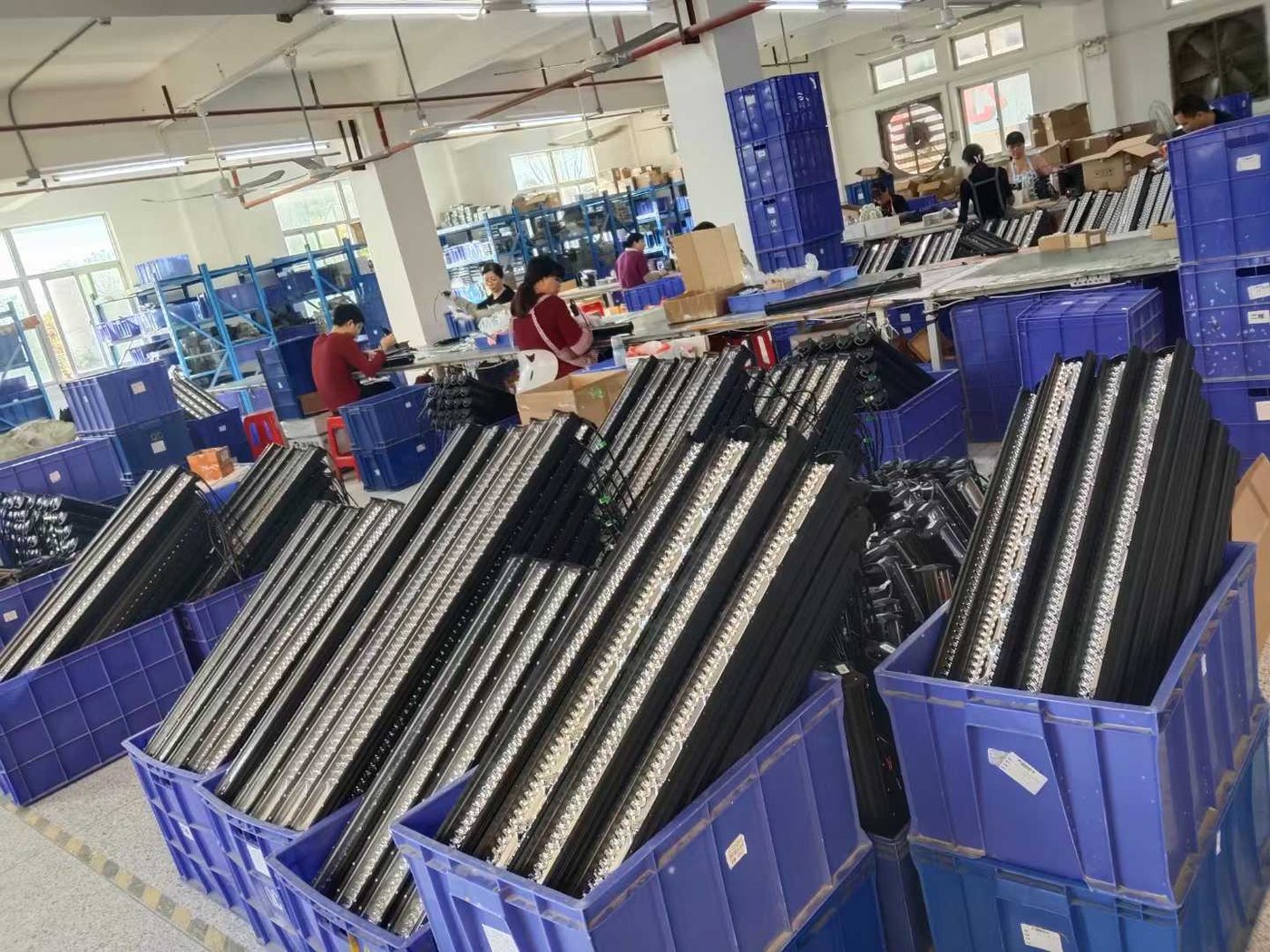
The LED lighting industry in China is not distributed; it is concentrated. Housing moulds, die-casting, PCB assembly, cable harnesses, gaskets, cartons and print — for the major production regions these suppliers sit within an hour of each other. A missing part is a same-day van ride, not a three-week European procurement cycle. Coordination cost is a real cost, and clusters minimise it. It also means a factory can hold almost no inventory and still promise short lead times, because its suppliers are holding it for them.
3. Certification, amortised
An ECE approval, a full IP test programme and EMC testing cost real money wherever you do them. A factory that runs one test programme across a production run of fifty thousand lamps carries a few cents per lamp. The same programme over two thousand lamps carries a few euros. This is one of the quiet reasons approved lamps from a large factory can be cheaper than unapproved lamps from a small one — and why, in this trade, the certification question and the price question are the same question. Our compliance hub covers who can hold which approval.
4. Labour is the smallest line, not the biggest
Everyone assumes labour explains the gap. For a modern LED lamp it rarely exceeds five to ten percent of the factory price: assembly is minutes per unit, and the automated parts — SMT lines, potting machines, die-casting — cost roughly the same everywhere. The lamp is not sewn together by hand. If a quotation is dramatically below its competitors on identical specification, labour is almost never the reason, and it is worth finding out what is.
5. The rebate and the currency
Exported goods have the domestic VAT refunded to the exporter — 13% for most lighting HS codes at the time of writing; verify the current schedule for your code. On top of that, factories price in dollars and buy in yuan, and the exchange rate has historically worked in their favour. These two items are genuine, legal and structural — and unlike the others, they are invisible on the quotation, folded into the FOB price. They are also the items most sensitive to policy: rebates get adjusted, currencies move, and a factory living on the rebate margin is more exposed than its quotation suggests.
6. The channel: the largest single variable
Come back to Figure 1. Between the factory price and the shelf price sits the biggest block of all, and it is optional. Every layer you remove from the chain — buying direct, consolidating shipments, holding your own stock instead of paying a distributor to hold it — moves that block from other people’s income statement to yours, partly as saving and partly as workload. This is the actual business case for importing, and it is also the honest statement of its risk: the importer’s margin is not pure profit, it is payment for warehousing, warranty handling, market knowledge and the right to be blamed first.
Where the Money Goes Inside the Lamp
Now open the housing. When a quotation is genuinely lower than another quotation for the same-looking lamp, the difference is nearly always inside this list. Each component has a budget version and a specified version, and the budget versions are not counterfeit or defective — they are real products, made to a price, that will work on the day they are unpacked:
| Component | Budget build | Specified build | What the difference buys |
|---|---|---|---|
| LED source | Unbranded 3 W chips, flux and colour bin unspecified | Named chips with stated flux and colour bins | Consistency between lamps, and between this year’s and next year’s batches |
| Driver | Non-isolated, no EMC filter, minimal protection | Isolated or protected; filter, surge and reverse-polarity clamps | Survives vehicle voltage spikes; passes ECE R10 |
| Housing | Thin die-cast or stamped steel | Die-cast aluminium at a stated wall thickness | Heat sinking — the single biggest factor in flux maintenance |
| Lens | PS or unspecified PC | UV-stabilised polycarbonate, resin stated | Stays clear instead of yellowing within two seasons |
| Sealing | Foam or recycled gasket, dry entry | Silicone or EPDM gasket, potted cable entry | The difference between a claimed IP rating and a real one |
| Cable and connector | Thin-gauge cable, unbranded connector | Stated gauge, sealed Deutsch-type or equivalent | No voltage drop, no corroded pins after the first winter |
| Fixings | Zinc-plated mild steel | Stainless or adequately coated hardware | Brackets that undo again at the second service |
| Packaging | Single-wall carton, no insert | Drop-tested carton with formed insert | Arrives assembled, aligned and working |
The important observation is that no single line above is decisive, and that is exactly the problem. Swap one component and the lamp still works; the customer never sees the difference on day one. The cost appears distributed over time — as yellowed lenses in season two, corroded connectors in the second winter, a flux curve that drops faster than the warranty period, an EMC complaint from a fleet that cannot explain its intermittent dashboard faults. A cheap lamp is rarely cheap in any single component. It is cheap in six components by a little, and the little adds up to the price gap.
Three Kinds of Cheap
Not every low price means the same thing. In practice a quotation below the market lands in one of three zones, and the correct response is different for each:
The green zone is real and permanent: volume, clusters, amortised testing and a shorter channel are structural advantages, and they explain most of the honest gap between a Chinese factory price and a European shelf price. The amber zone is where most sourcing actually happens — the saving is genuine if the drawing is honoured, and the entire discipline of supplier verification exists to check that it is. The red zone is not a price at all. It is a transfer: the factory has moved a cost from its bill of materials into your future, and the exchange rate of that transfer is terrible.
| Red flag on a quotation | How it usually presents | How to check, today |
|---|---|---|
| Approval does not match the product | E-mark or cert number quoted without the product family, or a certificate whose photographs show a different lamp | Ask for the certificate and the tested configuration it describes; compare the marking drawing |
| IP claim with no test | “IP68” in the brochure, nothing in the documentation | Ask for the IP test report by report number and laboratory |
| Lumens quoted from the chip | Round numbers at improbably high output for the wattage | Ask for integral-sphere results on the lamp, at operating temperature |
| Material substitution | “Die-cast” housing that a magnet sticks to, or a lens with no resin stated | Ask for the material datasheet; weigh the sample against the spec |
| No EMC story at all | No R10 mention, no filter in the driver photos | Ask for the EMC report; it either exists or does not |
One caution cuts the other way, and it is worth saying plainly. A quotation that is low but lands in the green or amber zone is not a warning sign — it may be the most professional supplier you will meet, running a tight factory at scale and thin margin, and walking away from it because it is cheap is its own expensive mistake. The discipline is to find out which zone before deciding, not to assume that price encodes quality in one direction.
Eight Places a Lamp Gets Cheaper, and What Each One Costs You
The zones tell you where to look; this section is what you find. These are the eight levers, in the order they usually get pulled, with the consequence each one carries down the line.
1. The LED and its bin
The same “3 watt” chip family spans a wide range of actual flux, and the flux is sorted into bins at the factory. A lamp built with bottom-bin chips measures perhaps fifteen to twenty-five percent less light than an identical-looking lamp on top-bin chips, and the difference is invisible: the part number matches, the wattage matches, the beam photograph matches. What you lose is delivered light and consistency — and across a batch, colour variation between lamps that fleet drivers notice before you do. The check costs nothing: ask for the LED part number and the bin specification on the drawing. A factory that states both is telling you it buys on specification; one that answers “same as sample” is telling you it buys on price.
2. The driver, where the EMC filter lives
The driver is the most common place to save and the most consequential. The budget version is a non-isolated board with a simple constant-current stage and no input filtering. It works. What it omits is protection: surge clamping for load dump, reverse polarity, and above all the EMC filter that keeps the lamp from radiating noise into the vehicle’s own electronics. The symptoms of its absence arrive late and arrive badly — dashboard flicker, radio hash, camera interference — and they arrive on vehicles you do not own, attributed to your product. EMC compliance is not a paperwork exercise; R10 exists because unfiltered LED drivers genuinely do interfere with vehicles. Ask to see the driver schematic and the EMC report together.
3. Cable gauge and connectors
Half a square millimetre where the drawing says one and a half. The lamp works on the bench, and it works on the truck — until the cable run is long, or the current is high, or both, at which point voltage drop dims the lamp and heat ages the insulation. Connectors tell the same story: an unbranded copy of a sealed connector mates perfectly and corrodes perfectly, one season later. Neither failure is dramatic, which is the problem: cables fail quietly, and quiet failures read as “these lamps are junk” rather than “this cable is 0.5 mm².”
4. The lens resin
Three clear plastics, three prices, three fates. PS is the cheapest and yellows in UV within a season or two. Unspecified PC may or may not be UV-stabilised. Stated, UV-stabilised PC costs more and stays clear for the life of the lamp. Because yellowing takes one to two years to appear, a buyer who qualifies on sample photographs will never catch it — the first evidence is a customer complaint in year two, by which time the shipment is sold. Ask for the resin by name and put it on the drawing.
5. The gasket and the IP claim
An IP68 claim costs nothing to print. A real one costs a gasket in the right material, a potted or properly sealed cable entry, and a test programme. The budget path is a recycled-foam gasket that compresses once and never recovers, plus a cable gland that relies on the installer’s care. It passes the day it ships; it fails after its second pressure-wash or its second winter of thermal cycling. We have written a whole guide on what the IP numbers actually test; the sourcing version is shorter — ask for the test report number, and ask whether the entry was potted.
6. The housing
Two die-cast aluminium housings can differ by forty percent in weight, and weight is heat-sinking surface, thermal mass and stiffness. The thin version casts and machines faster, ships lighter and runs hotter — and LED lifetime is a direct function of junction temperature. A lamp that loses fifteen percent of its flux in two years because it runs twenty degrees hot has not failed catastrophically; it has quietly become a dimmer lamp, which the market will also describe as junk. Ask for the housing weight on the datasheet; it is the cheapest thermal specification there is.
7. Fixings and brackets
Zinc-plated mild steel screws cost cents less than stainless. They also seize with rust after their first road-salt winter, which means the second service — the one where a technician swaps a failed lamp — takes twice as long and sometimes involves a grinder. On a fleet of any size, seized fixings are a real maintenance line item, and the fixings were the cheapest part of the lamp. Check the hardware specification; it is the sort of detail that separates a factory that has ever serviced its own products from one that has not.
8. The packaging
A single-wall carton without an insert is a dollar saved per lamp and a scrap rate at the other end. Lamps ship assembled, stacked, thrown, and stored under other cartons; the ones without formed inserts arrive with bent brackets and cracked lenses, and the claim lands on whoever imported them. Packaging is the cheapest place in this entire list to buy quality, and the strangest place to economise. Ask what the carton survived in testing.
Cheap Per Unit, Expensive Per Year
The reason the eight levers matter is that lamps are not consumed once. They are bought, installed, failed, replaced and re-installed across the life of a vehicle, and the purchase price is only the first term in that series. Below is the arithmetic for a mid-size fleet — the calculation almost nobody runs before placing a first order:
Two honest observations about this chart. First, the cheap lamp’s case is not stupid — if its five-year failure rate were 10% instead of 35%, it would win on cost, which is precisely why the verification in the amber zone is worth performing rather than assumed either way. Second, the largest block in the cheap lamp’s column is downtime, not parts, and downtime is the term a factory quotation will never include, because it is not theirs to price. That asymmetry is worth remembering whenever anyone compares “the same lamp” at two prices: the columns are not equal, and only one of them shows its real size after year one.
How to Compare Two Quotations That Look Nothing Alike
Most bad sourcing decisions are comparison errors, not price errors. Two quotations arrive for “the same” lamp, one is 30% cheaper, and the difference is distributed invisibly across eight components, three documents and two definitions. Before comparing, force both quotations onto the same grid:
| Align this field first | Why quotations differ on it |
|---|---|
| LED part number and bin | Identical wattage, entirely different flux and consistency |
| Delivered lumens at operating temperature | Chip datasheet numbers quoted as lamp output |
| Driver type, protections and EMC report | The filter is invisible in photos and expensive on the BOM |
| Housing material, weight, wall thickness | “Die-cast aluminium” covers a 40% weight range |
| Lens resin, stated | PS and UV-stabilised PC photograph identically |
| IP rating and test report number | The claim is free; the report is not |
| Cable gauge and connector specification | 0.5 mm² and 1.5 mm² look the same coiled in a box |
| Approvals: which mark, whose name, cert number | An approval for a different product family is not an approval |
| Sample source | A golden hand sample quoted; a production unit shipped |
| Incoterm and quote validity | FOB versus DDP differs by everything in Figure 1 |
| Warranty terms and failure definition | “Two-year warranty” that excludes labour and shipping is a shorter warranty |
| Golden sample retention | Without it, batch two is a new negotiation you cannot see |
The discipline takes an hour and settles arguments that would otherwise take a shipment. It also has a side effect worth more than the comparison itself: the questions themselves sort suppliers faster than any audit. Factories that hold documents send them the same day; factories that buy from documents write back asking which ones you need. Neither answer is disqualifying, but they are different businesses, and you should know which one you are buying before the deposit, not after. Our seven-check verification guide turns this into a sequence.
What a Fair Price Actually Looks Like
We will not print a price list — any honest number depends on the product, the quantity, the specification and the destination, which is exactly why sites that publish one price per product are telling you very little. But there is a way to recognise a fair price without a benchmark, and it is this: a fair quotation is specific. It names the LED and the bin, the driver protections, the resin, the gasket material, the cable gauge, the housing weight, the approval holder and the certificate number. It quotes the incoterm. It has a validity date. Its specificity is the price’s signature.
The reverse is equally reliable. A quotation that says “same as photo”, “IP68” without a report, “high lumen” without a number, and “best price for you, my friend” is not necessarily dishonest — it is a factory quoting a product it does not document, which means a product you cannot verify, hold to drawing, or transfer to a second supplier. Cheapness without specificity is not a price; it is an absence of information, and information is what you are actually buying when you buy a specification.
And one more calibration, because this article is easy to over-read: the goal is not the most expensive lamp. There is a real trap at the other end, where a buyer who has been burned once starts specifying military-grade everything and pays double for performance a regional haulage fleet will never use. The eight levers in this article are a checklist for understanding a quotation, not a shopping list. Specify what your market’s failure modes demand; ignore the rest; and let the arithmetic in Figure 3, run with your own numbers, make the final call.
Eight Things to Do Before You Accept the Lower Price
- Classify the cheapness. Structural (green), verification-dependent (amber) or risk-transfer (red). Figure 2 is the checklist; decide before negotiating anything.
- Align the twelve fields across every quotation you are holding. Table 4 is the grid. Unaligned comparisons are how the wrong supplier wins.
- Ask for the documents by number: IP test report, EMC report, approval certificates with the tested configuration. Documents exist or they do not.
- Weigh and measure the sample. Housing weight against the datasheet, cable gauge against the drawing, lens resin by name. Fifteen minutes with a sample answers five of the eight levers.
- Get the golden sample retained and referenced on the PO — and keep your own counter-sample. Batch two is where silent changes happen.
- Run the five-year arithmetic with your failure-rate assumption, your labour rate and your downtime cost. If the cheap lamp still wins with honest numbers, it is not a cheap lamp; it is a bargain.
- Price the warranty you are actually buying: who pays freight on a claim, what counts as a failure, and whether the term excludes anything a fleet will actually experience.
- Start smaller than the MOQ tempts you to. A first order is a test of the documents, not a bargain on unit price. The MOQ guide covers how to buy the first run at a sensible size.
Frequently Asked Questions
Is a cheaper Chinese lamp automatically worse quality?
No — that assumption is wrong in both directions. Volume, industrial clustering, amortised testing and a shorter distribution chain are genuine structural advantages that lower price without touching specification. Equally, some low prices are silent specification transfers that you pay for over five years. The price tells you nothing on its own; the documentation tells you everything. Judge the quotation’s specificity, not its total.
Why can the same lamp differ 40% between two Chinese factories?
Because “the same lamp” is a shape, not a product. Behind identical housings sit different LED bins, different drivers, different resin, different gaskets and different test budgets — or different scale: a factory running fifty thousand units a year through the same mould recovers fixed costs a niche maker cannot. The 40% is usually three parts scale, three parts specification and four parts channel.
How much does the export rebate actually save?
The VAT rebate on exported goods — 13% for most lighting HS codes at the time of writing, but verify the current schedule — is already folded into the FOB price you are quoted, so you never see it as a line. Its significance is strategic rather than arithmetic: a factory whose margin lives substantially inside the rebate is exposed to policy changes, which is a reason to prefer suppliers with margins that survive without it.
What share of the retail price reaches the factory?
For a lamp sold through the conventional importer-distributor-retailer chain, roughly a quarter, and that quarter includes the factory’s own materials, labour, overhead and profit. This is the single most useful number in this article for a distributor: the mark-up you are competing against is not manufacturing cost, it is three businesses’ cost structures stacked on top of a quarter.
Should I ask a factory to match a competitor’s lower quote?
You can, and a transparent factory will tell you which of the eight levers it would have to pull to match — that conversation is worth more than the saving. But a factory that simply agrees to any number without asking what it may change is quoting to win the order, and the difference will come back as a substitution you did not approve. Matching is only meaningful when both quotations are aligned on Table 4’s twelve fields first.
What failure rate should I plan for?
For specified lamps from a qualified factory in normal duty, low single digits over five years is a realistic planning figure; for budget builds in the same duty, the number can be an order of magnitude higher, dominated by connectors, gaskets and drivers. But the honest answer is that you should not plan on anyone’s number — run a first-order field trial, count your own failures, and let Figure 3 use your data. Your own failure count is the only one your fleet believes.
Do I need third-party inspection if the factory has its own QC?
Yes, for the first orders at least — not because factory QC is bad, but because it is measuring against the factory’s standard, and the entire risk in this trade is that the standard quietly differs from yours. A pre-shipment inspection against your golden sample and your twelve-field specification costs little and converts “trust” into evidence. Once several clean shipments exist, you can lengthen the interval; never skip it entirely on a new product or a new factory.
Why doesn’t JTPART publish prices on the website?
Because the honest number depends on four things that vary per customer: the specification depth you choose, the quantity, the incoterm and the destination market. A published price would either be high enough to scare off buyers it should not scare, or low enough to be unkeepable — and either way it would tell you less than a specific quotation after a ten-minute conversation about your requirements. This article is the honest version of that reasoning: understand the structure of the price, then ask for one.
Working with JTPART
We are a supplier of LED lighting for trucks, trailers, buses and plant machinery — nine product families from warning and safety lamps to headlamps — and we are not a factory. In the language of this article: we sit early in the channel, we buy from partner factories against specifications rather than photographs, and the approvals involved are held by those factories, not invented for the brochure. Our job in a conversation about price is to tell you which zone a quotation lives in before you commit — including, on occasion, advising a customer that the cheaper option is the right one for their market.
In practice that means every quotation we issue names the LED and its bin, the driver protections, the resin, the sealing method, the cable, the housing and the approval documents behind it — and where a budget build is genuinely the sensible choice for a customer’s application, we will say so and quote it as what it is. We do not publish prices, for the reasons in the FAQ above; we do publish the structure of the price, which is the part you can check us on.
Ask for a specific quotation → or start from the range: work lights, warning & safety lamps, light bars, tail lamps and marker lamps.